"One
of the rocket soldiers said that a 'special new
weapon' would be fired that evening around 8:00
PM, and the crews were unsure if the ground was
firm enough to support the weapon. The soldiers
told us we should leave our home because there
was a possibility the weapon might topple over
and explode, destroying nearby houses."
"Mother did not believe this, but at exactly
8:00 PM there was a thump and roar of the rocket
coming to life. I thought my lungs would blow
apart. Mother ran to the window in time to see
the rocket rise over our home. The noise from
the engine stopped and few seconds later the
rocket went down on the west dune at
Scheveningen."
Den Haag resident Rita Winter
Because
of the sweeping Allied advances just weeks earlier,
many Dutchmen in the province of South Holland
believed the war would be over before Christmas of
1944. On September 5, 1944, there were many rumors
about the fast-approaching Allied armies. However,
the citizens were unaware of the overextended supply
lines slowing the advance, which would soon become a
crawl. Although they had grown accustomed to the
sights and sounds of war, the Dutch were about to
face another trepidation. Their suffering would not
end soon.
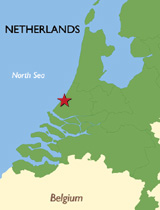
It had been a warm, sunny afternoon in
the affluent suburb of Wassenaar, just northeast of
The Hague (Den Haag). On that day, September 8,
1944, the citizens heard a different kind of sound.
A tremendous roar filled the air, furniture and
windowpanes shook, and the ground began vibrating.
Dutch civilians exited their homes in time to
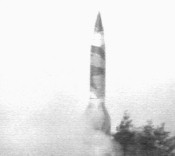
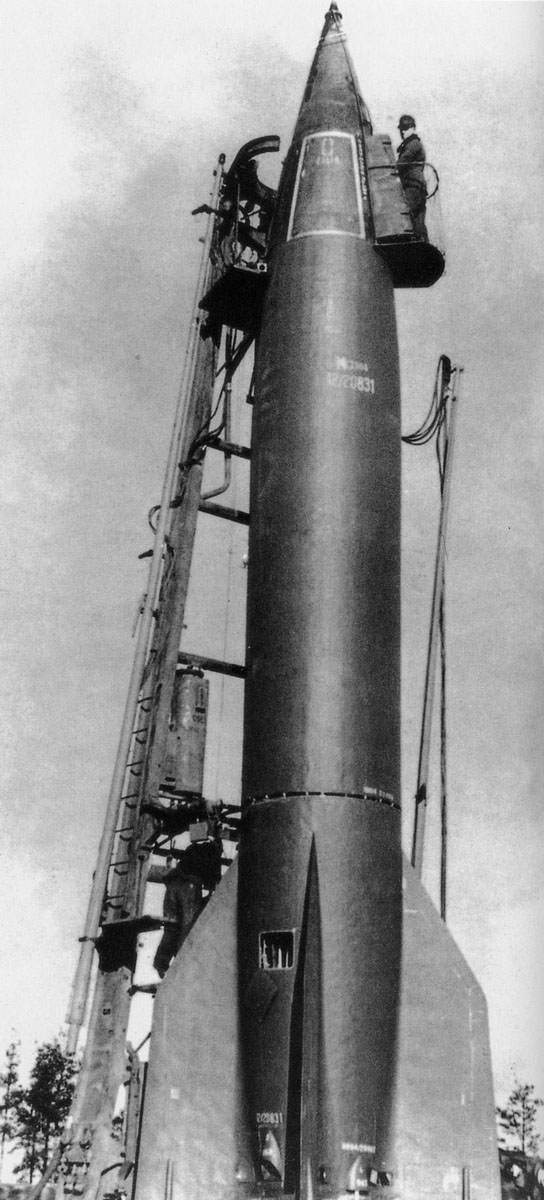
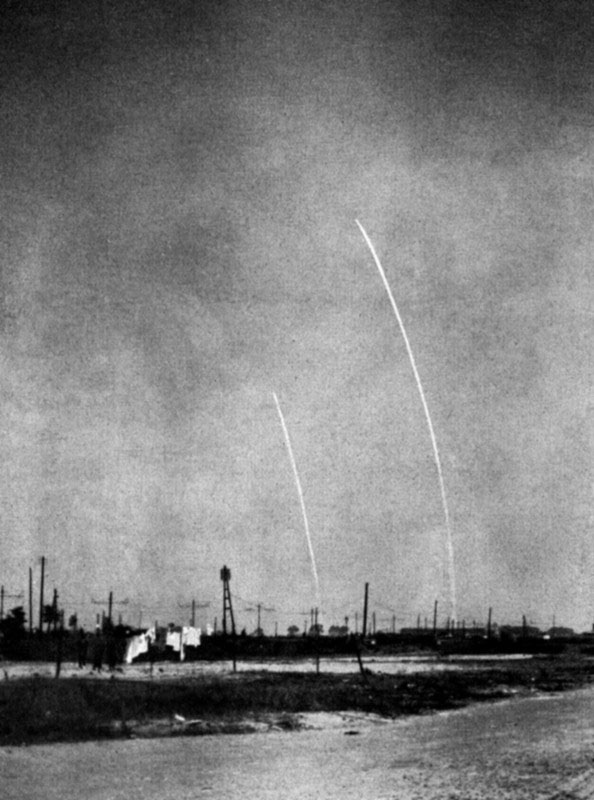
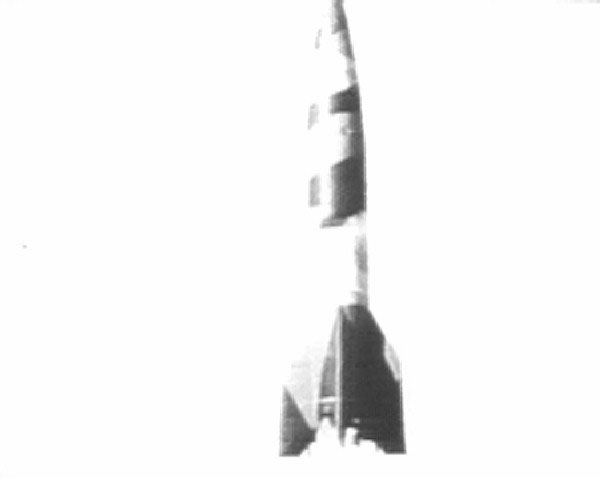
witness two pointed projectiles, about 50 feet long,
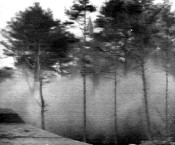
rising slowly above the treetops. A cloud of smoke
rolled through the streets after the rockets had
cleared the trees. They gained speed rapidly with
flames emerging at the rear extending to more than
half their lengths. As the rockets moved higher and
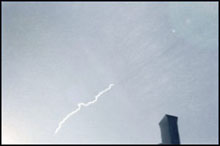
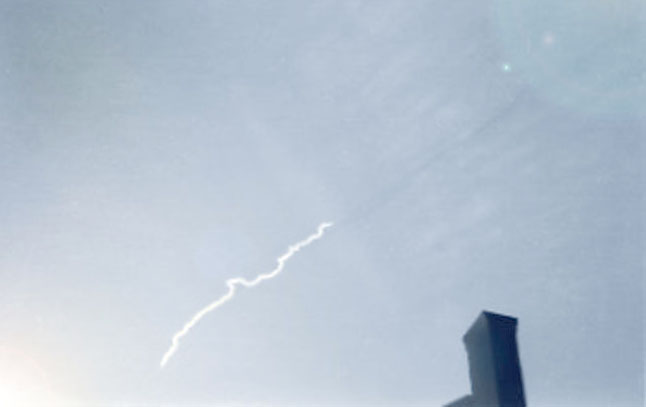
higher into the heavens, a white trail appeared in
the form of a spiral. The smoke disappeared at a
height of about 12 miles, and the projectiles
accelerated rapidly, their trajectory flattening out
somewhat. They finally disappeared traveling at a
terrific speed.
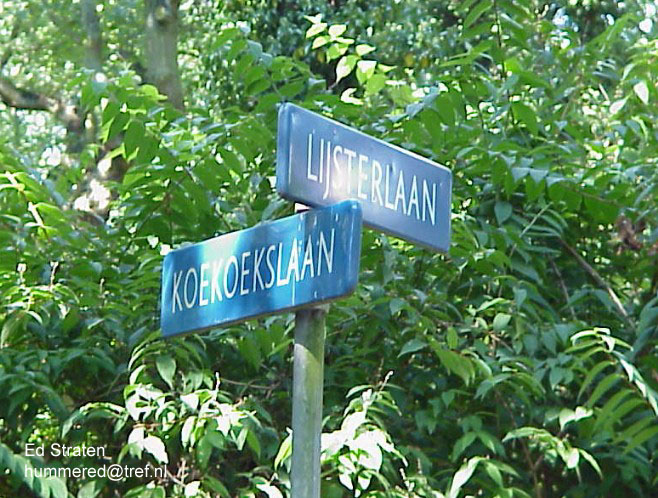
Under the command of
Colonel Hohmann, platoons from the second battery of
Artillery Battalion 485 (2./485) had launched two
rockets simultaneously at 6:36 PM from the
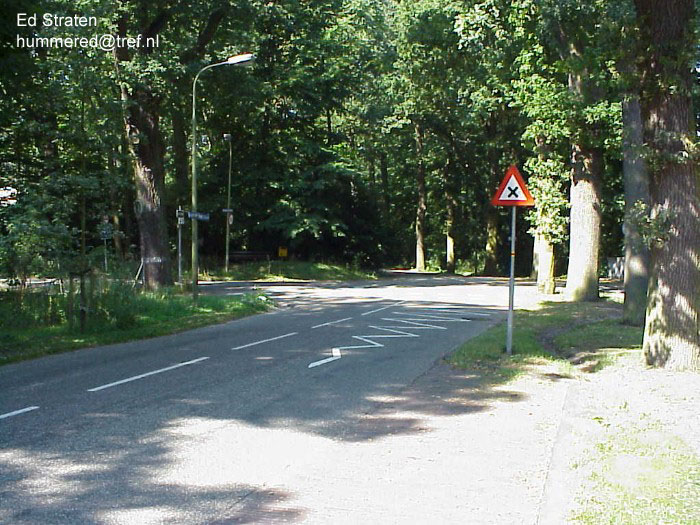
picturesque neighborhood streets: one from the
intersection of Lijsterlaan, Konijnenlaan, and
Koekoekslaan; the other, about 150 feet away, from
the intersection of Schouwweg
and Rust en
Vreugdlaan.
Mr.
C. van Fliet
lived in
Wassenaar. He
remembered
those first
missiles. I
heard a
terrific noise
as though 30
aircraft were
flying low
overhead, a
noise such as
I had never
heard. I
looked up to
see two
pointed
projectiles,
about 10
meters long,
rising slowly
above the
treetops. A
cloud of smoke
billowed
slowly after
reaching a
height of
about 15
meters. The
projectiles
gained speed
rapidly with a
flame emerging
at the rear
extending to
more than half
their
lengths. Van
Fliet recalled
that, the
thunder of the
rocket engines
was
tremendous.
One of the
rockets from
Wassenaar
ended its
five-minute
journey
traveling
three times
the speed of
sound when it
slammed into
English soil
at Staveley Road in Chiswick. The other rocket
came down in a
field at Epping (north of London).
The thunderous
impact at
Chiswick
echoed all
across London.
First,
a whip
cracking
sound was
heard, which
was created by
the rocket
moving faster
than the speed
of sound, as
the air
pressure
bounced off
the point of
impact split
seconds before
the flash of
impact. The
explosion of
the warhead
churned debris
and earth
skyward.
Almost
immediately
afterwards, as
in reverse
order, the
whine and rush
of whistling
air was heard
as the rocket
descended,
followed by
the ominous
roar of the
incoming
rocket, before
it tapered off
to silence.
The explosion
had killed
three people,
including
Private Frank
Browning, who
was in a hurry
that payday to
visit his
girlfriend s
house.
Seventeen
other people
had been
seriously
injured in the
blast, covered
by the debris
of their
wrecked homes
until rescue
workers pulled
them free.
Eleven homes
situated on
Staveley Road
were totally
flattened,
while two
dozen more
sustained
substantial
damage. As
more and more
residents
emerged from
their homes many
were
surprised to
find the blast
radius was so
broad; windows
of houses
almost two
miles away had
been blown out
by the
tremendous concussion.
The whole area
was
impassable.
"The
horrors of the war are increasing due to the V-2
launching sites. We see fires burning in The
Hague, huge columns of smoke. We heard the
screaming bombs falling on Bezuidenhout, which
brought death and misery only a hundred meters
from us. At the same time we see the rockets
launching, the roaring and flaming V-2, holding
our breath to see if the launch was successful,
if not, will it fall back on the homes of
innocent people. It is horrible to see the
monsters take off in the middle of the night
between the houses, lighting up the skies. One
can imagine the terrors that come upon us now
that The Hague is a front-line town, bombed
continuously for more than ten days. Buildings,
burning and smouldering furiously, a town
choking from smoke, women and children fleeing.
What misery, what distress."
Quote from the Resistance newspaper Trouw
That morning,
the German firing
crews in Wassenaar had
hoped to get an
earlier start.
However, the strong
winds from the passing
storm had knocked down
a tree, which
fell on one of the
radio tents of the
Brennschluss position
several miles away.
Finally, late in the
afternoon around 4:30
PM, German trucks and
odd-looking vehicles
were seen driving up
to the Wassenaar sites
coming from the
direction of
Raaphorst. One of the
vehicles was described
by eyewitnesses as a
long trailer having
many wheels with some
sort of lifting
apparatus
(Meillerwagen). Others
included tanker trucks
and trailers, which
were filled from a
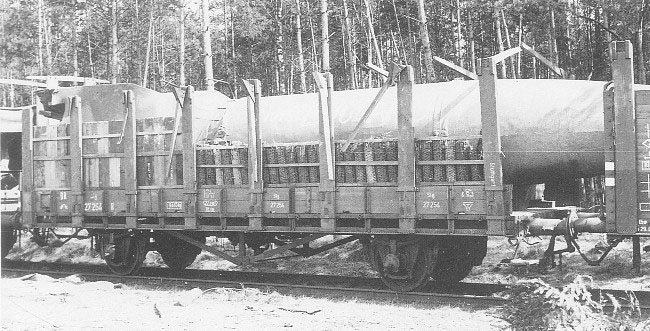
railway wagon at
Wassenaar Station, and
an armored halftrack,
which had been left
about 1,000 feet away
from the launching
positions.
Occupants of the
nearby houses had been
evicted the day before
by German military
guards who ordered
them to leave their
doors and windows
opened; no one was
allowed within half a
mile of the area, but
the noises and flurry
of activity prompted a
few daring souls to
venture closer for a
peek. The launching
crews consisted of
about 20 soldiers who,
when fueling the
missiles, were
completely clad from
head to toe with
asbestos-like
protective overalls
and helmets. It was
later discovered that
the projectiles were
fired using a power
cable brought out from
a nearby electrical
supply point. The
Germans had installed
a number of these
electrical cables,
connected to normal
power mains, which
positioned in the
neighborhood via the
roads Rijksstraatweg
and Rust En
Vreugdlaan.
Mr. Van Fliet
visited the
launching site
as soon as
possible after
the event.
Both firing
positions were
in the middle
of roadways
passing
through the
tree-lined
neighborhood.
At each
launching
place, there
was a circular
patch where
the road had
been melted or
burned. The
burned patch
had a diameter
of 9 meters
and the road
was about 10
meters across
at the longest
point. In the
center of each
burned patch
was an
unburned area
in the form of
a box
suggesting
that some sort
of stand was
used to cradle
the missiles.
The trees near
the edge of
the roadway
were very
badly burned
up to a height
of about 1
meter and less
badly burned
near the
treetops.
There was also
evidence of a
violent low
blast, as the
grass was
flattened out
and all the
leaves had
strangely
vanished from
the ground
below the
trees. The
thatched roof
of a nearby
small house
had been
lifted and
blown off.
Immediately
after
launching the
missiles, the
soldiers of
second battery
of Battalion
485 (2./485)
packed their
equipment and
drove away
from the
launching
area. On the
following day,
a report from
the V-2
command post
at
Duivenvoorde
Castle in
Voorschoten
was forwarded
to Division
z.V. (Division
for
Retaliation)
at General
Kammler s
headquarters:
The rocket
weapon was
effective. Two
rounds
launched
against
London. In
London,
military
officials knew
immediately
what had
happened the
V-2, code
name
Big Ben, had
finally
arrived on
British soil.
In 2004 city
officials from
both Wassenaar
and Chiswick
presided
over
ceremonies for
the dedication
of markers
in both cities
indicating
the launching
point and impact
point for this
first
V-2 attack.
Planning
for the rocket
attacks had
begun months
before. German
scouts,
transport
specialists,
and surveyors
had visited
The Hague in
July and
August of 1943
to identify
potential
launch sites
and support
areas for
rocket
operations.
They traveled
around The
Hague,
Rijswijk,
Wassenaar,
Loosduinen,
Ockenburgh,
and Leiden.
Members of the
Vermessungsbatterie
(Survey
Battery) from
Peenem nde
carried out
triangulation
measurements
at
predetermined
locations. Each
potential
launching
point was
calculated in
this manner.
Members of the
Erkundungsstab
(Exploratory
Staff) had
arrived to
determine
where the soil
was suitable
for firing the
heavy missile.
Ground
pressure tests
were carried
out at the
Duindigt
estate in
Wassenaar and
ten months
later the V-2
troops would
indeed set up
launching
sites at
Duindigt. At
many points,
site markers
were hammered
into the
ground in
order to be
able to find
the designated
places later
on. In
addition, the
units examined
the roadway
Rijksstraatweg
between Leiden
and The Hague,
which provided
the main route
between the
transport
depot and
firing
locations.
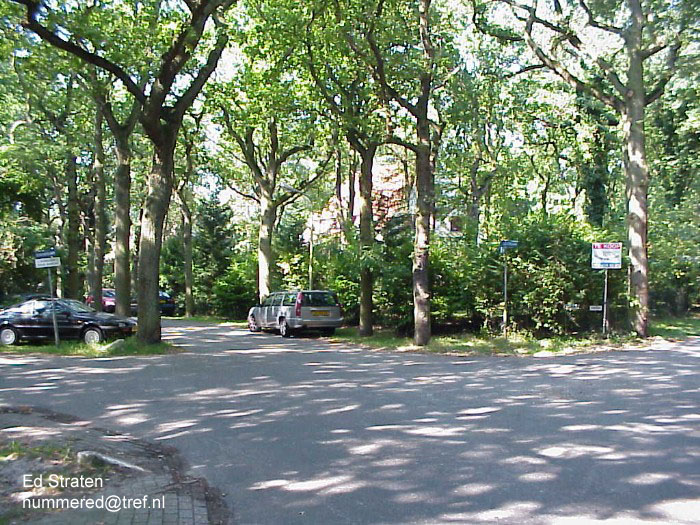
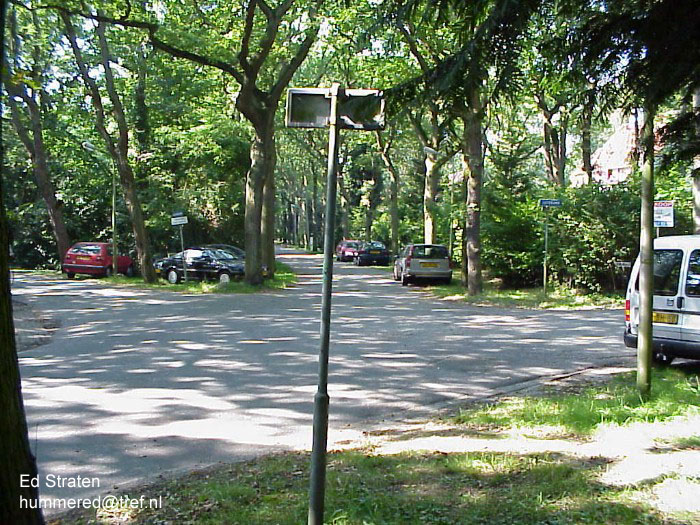
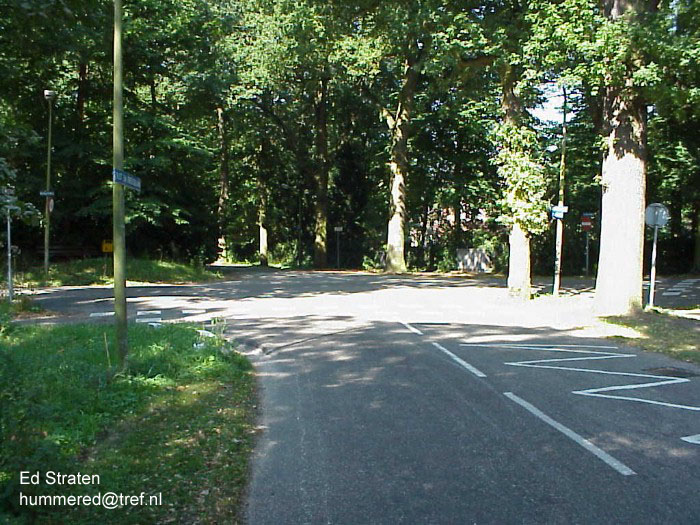
Photos
on left: 5
photos (top) of the
intersection of the
streets Koekoekslaan/Schouwweg/Rust
en Vreugdlaan
in Wassenaar 2014.
3 photos
(bottom) of the second
launch site about 50 meters
away at the
intersection of Lijsterlaan/Koekoekslaan/Konijnenlaan.
From these spots the
first two rockets
targeting London were
fired on Sept. 8, 1944.
-
At the start of the campaign on August 31,
1944, the first and second batteries of
Battalion 485 (1./485 and 2./485) boarded
trains at Schneidem hl/G lzow in Hinterpommern
for transportation to the deployment area. On
September 3, the batteries reached
Kranenburg/Kleve and were assembled to proceed
with their journey to the coast, commencing
that same evening. Progressing in a convoy of
trucks, tractors, and trailers, they reached
the vicinity of Steensel/Eindhoven on
September 4. From there, the paths of the two
batteries split ways, with the 1./485 moving
through Tilburg, and the 2./485 traveling via
Turnhout. Traveling without fuel reserves, the
1./485 arrived in Breda. They then headed
towards Bergen op Zoom
but encountered retreating German forces,
causing to the convoy to turn back. Several
battalion vehicles were left behind due to
running out of fuel. Battery 2./485 traveled
through Turnhout and Huijbergen on its route
to an area south of Bergen op Zoom, in the
woods of Wouwse Plantage.
The coastal areas of Belgium were
being overrun by advancing Allied forces. The
disorderly circumstances led to the
destruction of the bridges over the Scheldt
and the Scheldt Canal. The intended
operational zone for the rocket batteries was
now inaccessible. As British and Canadian
forces moved to secure Antwerp, it was rumored
that a trainload of V-2s had to be hastily
withdrawn from the area north of Antwerp. Due
to the evolving situation in the region, the
rocket convoys altered their plans and set
course for The Hague on the Dutch coast. The
two batteries of 485 each chose their own
route. Battery 2./485 moved through Raamsdonk
and Rotterdam to Castle Haarzuilens near
Utrecht. On September 6, 1944, they left for
The Hague with the 2./91 Technical Battery.
On September 9, 1944, RAF
aircraft, informed by the Dutch Resistance,
targeted the site of the first V-2 launches,
but the rocket troops had already left. The
field store positions of 2./91 Technical
Battery were attacked at Rust en Vreugd, which
resulted in losses of men and material. The
second battery of Battalion 485 (2./485) had
set up operations on the grounds of the
Beukenhorst estate, a few miles to the
southwest; firing only one missile this day,
which fell into the sea. On the same day,
after completing their journey from Tilburg to
Utrecht, Battery 1./485 successfully
integrated with the second battery and began
participating in firing operations. Following
this, the mobile batteries underwent a
strategic relocation to new firing sites in
the areas of Wassenaar and The Hague.
-
A-STOFF LOX TRAILERS BEHIND A TATRA 111
TRUCK IN TILBURG AREA
The soldiers moved onto the
grounds of the large Duindigt estate. A
branch from the local tramway network was
used to supply power to the launch sites,
which were dispersed over the large
estate. Later that day, around 9:25 PM,
the 1./485 at Beukenhorst fired a V-2 that
impacted in England at Fambridge in Essex.
The rocket disintegrated before impact
causing only light damage to buildings on
two farms. The next day, September 11, two
batteries of Battalion 485 fired three
rockets from Beukenhorst. One rocket fell
in Crockenhill, Orpington, Kent. Another
came down at Magdalen Laver, falling in a
farm meadow.
The recent RAF air
attacks prompted
local government
officials to order
the evacuation of
Wassenaar, with the
exception of the
area behind the
Kerkdam. Within
three days, the
entire area between
the viaduct on the
Leidschenstraatweg
and Kerkdam,
including Marlot
Park Fliet, was
evacuated. The
departure of the
thousands of
residents from the
threatened area was
not fully completed
when another air
raid followed. On
September 14, around
1:30 PM, the first
bombs fell on
Raaphorst, near the
place where some
rockets were
reportedly observed.
Three days later,
there was a larger
bombardment of the
same area.
Even
though the
rocket attacks
had begun, the
concerns of
the launching
crews were far
from over.
Fuel and
supplies,
especially
liquid-oxygen,
were being
brought in
from Germany
in
frustratingly
small amounts.
The rockets
were another
problem. By
the time they
reached their
launching
sites, more
than half were
not fit for
firing. With
only two
platoons and
two firing
tables, 1./485
was lacking
vehicles and
equipment and
struggled to
launch many rockets.
ANNOUNCEMENT FOR
EVACUATION OF
WASSENAAR
FOLLOWING FIRST V-2
LAUNCHES
-
Daily
technical
reports coming
to
headquarters
reported a
variety of
problems such
as oil in the
liquid-oxygen.
This occurred
when the
liquid-oxygen
had been
stored too
long in the
transport
bowser. The
oil residue
caused
explosions
upon ignition
of the
combustion
unit. A
thorough
cleaning of
the bowsers
cleared up
this problem
and stopped
the
explosions,
but damage to
materials and
to the launch
sites caused
further
delays.
General
Dornberger s
chief supply
officer had
moved the
rockets by
train from the
Mittelwerk
factory at
Nordhausen to
the area of
Koblenz, where
they were
stockpiled in
depots along
the German
border. Once
at the border,
LXV Corps
transported
them to the
main storage
facility where
the 511 Field
Workshop
Company
unloaded and
stored the
rockets until
they were
required.
There they
remained for
weeks at a
time. When
they were
finally
brought over
to the
launching
crews, many of
the V-2s were
in poor
condition.
Vital
components had
corroded away,
and the
electrical
systems were
especially
vulnerable.
Because of
these
conditions,
the rate of
fire was well
below Hitler s
imagined
onslaught. The
familiar
airburst
problem, along
with in-flight
mechanical
problems,
caused many
rockets to
fall in the
North Sea or
in sparsely
populated
areas.
SS General
Kammler s
staff, which
was thrown
together at
the last
minute, was
unable to cope
with all
questions
arising after
the start of
the rocket
offensive.
Because of his
military
command
inexperience,
he made many
elementary
mistakes. For
example, after
the start of
the offensive,
Kammler could
not get in
touch with his
troops. He
knew nothing
of their
whereabouts,
particularly
Battalion 485
in the
Netherlands.
Some of the
most essential
equipment and
spare parts
had been left
behind. On
September 5,
the day
designated for
the offensive
to begin, the
troops
discovered
that no
warheads had
been shipped
to the
operational
areas, which
postponed the
opening of the
offensive for
several days.
The battalions
went into
action with
specialized
tankers,
trailers, and
trucks to
carry the
rocket fuels,
but the
motorized
columns had no
tankers along
to carry
regular
gasoline for
their
vehicles. When
told of the
problem,
Kammler
suggested the
troops should
just fill up
the emptied
alcohol
tankers with
gasoline.
Immediately,
the coating
inside of the
tanks specially
made for the
storage of
alcohol was
completely
ruined. The
alcohol
tankers, which
were in short
supply and
needed at the
front, had to
be sent back
to Germany for
repairs.
On September
12, the
soldiers moved
into apartment
billets at
Marlot,
adjacent to
the Duindigt
estate. That
day, between
the hours of
6:00 AM and
9:40 PM, five
more V-2s were
launched.
Londoners were
treated to
more of the
mysterious
bangs, one of
which landed
on the
Chrysler
manufacturing
plant at Kew
Gardens,
killing eight
people and
causing
extensive
damage. On
September 14,
two rockets
launched from
Wassenaar
failed one
from the
intersection
of the streets
Schouwweg and
Oud
Wassenaarscheweg,
the other from
Beukenlaan and
Oud
Wassenaarscheweg.
Each one
crashed into
the North Sea,
just off the
coastline
north of
Kijkduin.
Another
launched from
the grounds of
the
Beukenhorst
estate
impacted
British soil
at
Walthamstow,
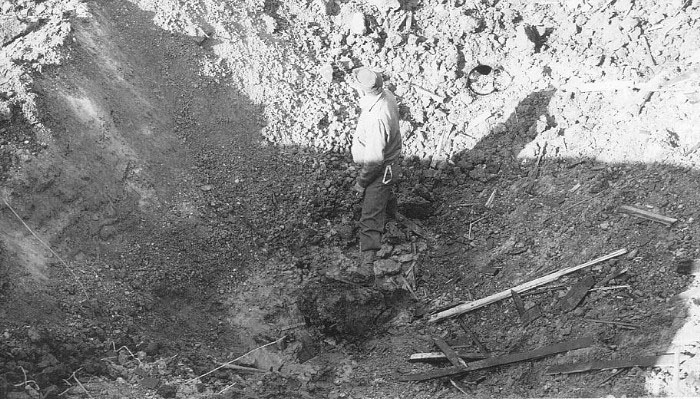
digging a
crater 25 feet
deep and
killing seven
people.
Quickly, the
Dutch
Resistance was
able to get maps and
messages
to the British
detailing the
new locations
and operations
of the German
rocket troops.
No. 229
Squadron was
the first RAF
fighter unit
activated to
counter the
V-2 threat. On
September 10,
two Spitfires
of No. 229
Squadron took
off around
7:00 AM from
RAF Coltishall
airfield, 8
miles
northeast of
Norwich. The
pilots
conducted a
reconnaissance
mission along
the coastal
parish of the
Netherlands
searching for
any signs of
rocket
activity. At
2:00 PM eight
more Spitfires
took off
flying over
over the
Zuiderzee,
then attacking
two trains
caught in the
open. On
September 13,
1944, the RAF
attacked the
anti-aircraft
positions
postioned
around the
royal estates
De Horsten.
Both
the RAF and
the U.S. Army
Air Force did
their best to
locate the
missiles, and
on many
occasions sent
hundreds of
fighters over
the
Netherlands to
strafe
anything that
looked like a
target. Anyone
caught in the
open risked
being
attacked.
Allied pilots
even shot at
civilian
cyclists on
the roads.
Even though
foxholes had
been dug at
various points
along the main
road of
Rijksstraatweg
to act as
quick shelters
in the event
of an air
attack,
corpses and
bicycles
frequently lay
beside the
main roads
near the
launching
areas.
Whenever the
planes came,
the German
soldiers would
dive into the
foxholes. At
one point on
the main road
from The Hague
to Wassenaar,
a large sign
read,
Achtung,
Strafing
Attacks:
foxholes
left!
But
because of the
rocket s
surreptitiousness
and
camouflaged
firing
positions, it
proved
difficult for
pilots to
locate the
rocket
batteries on
the ground. It
took Allied
Intelligence
quite a while
before they
found out just
how mobile the
new rockets
were. Not only
was the rocket
impossible to
stop after
firing, but
was also going
to be a major
headache to
stop on the
ground. Even
so, the
fighter-bomber
sweeps shot up
a lot of
vehicles and
railway cars
and were
partially
responsible
for shortages
of
liquid-oxygen
and other
supplies at
the V-2 launch
sites
throughout the
fall of 1944.
Just after
noon on
Sunday,
September 17,
1944, twelve
Spitfires of
No. 229
Squadron RAF
took off from
their base at
Coltishall.
Their mission
was to scan a
stretch of the
Dutch coast
looking for
evidence of
rocket
activity.
While
patrolling at
12,000 feet
over the north
part of the
Netherlands,
they witnessed
a V-2 rising
in the
distance at
terrific
speed. The
rocket
impacted
several
minutes later
in greater
London at
Coulsdon. The
Spitfires were
too far away
to discern the
exact location
where the
rocket had
been fired.
They could
only report
the general
location,
which was near
the coast,
possibly The
Hague.
Battalion 485
launched their
final rocket
of the day at
6:50 PM, which
came down at
Adelaide Road,
Brockley, at
Lewisham,
killing 14
people and
injuring
another 41.
Over a
five-day
period from
September
13-17, 1944,
fifteen rocket
impacts had
been recorded
in southern
England, with
about half
falling in
London.
-
ABOVE: AREAS OF EARLY V-2 OPERATIONS IN
WASSENAAR AND ENVIRONS
-
EARLY
V-2 OPERATIONS IN WASSENAAR AND THE
HAGUE____
-
Also on September 17, later in
the evening, acting on a tip from the Dutch
underground, 27 Lancaster bombers and 5
Mosquitos dropped their bombs over Raaphorst,
which included the surrounding area near
Beukenhorst between Raaphorstlaan and
Eikenhorstlaan. These heavily wooded areas
southeast of Wassenaar were suspected as
firing locations, but in fact only one
location on Brievenkastlaan had been used.
German personnel were surprised by the
unexpected bombardment and quickly sought
shelter. Dozens of bombs landed in the forest,
where they blasted wide craters into the loose
ground. 169 tons of Brisant high explosive
bombs and twenty-four 250-pound marker-bombs
were dropped. Three farms were damaged and a
house on the Raaphorst estate was blown into
ruins. However, there were no civilian
casualties because the farmers had received
prior warning of coming raid from the Dutch
Resistance. They were lucky only a few months
before, the Raaphorst estate was transformed
into a munitions depot. A large number of
wooden bunkers were laid into the grounds of
the estate, covered with a heavy layer of
earth. The British bombers disappeared with a
sharp turn in a westerly direction over the
sea. However, because the V-2 crews had
dispersed all of their materials under the
dense foliage of Ter Horst, the bombs had
little effect on rocket operations. Most of
the bombs hit west of Raaphorst, mainly on Oak
Horst. Approximately thirty trucks and six
Meillerwagens carrying tarpaulin-covered V-2s
passed by Raaphorst the following morning. The
area would be used no more for these and other
reasons.
In
September
1944, as the
Allied front
surged toward
the German
frontier, the
V-2 rocket
campaign
entered a
period of
frantic
movement and
mounting
tension.
Following
their transfer
to V-2 Group
North, Battery
444 and
elements of
Technical
Battalion 91
began a
strategic
shift from
Belgium toward
the Dutch
island of
Walcheren.
This move was
carefully
choreographed;
between
September 10
and 11, the
unit staged
through
Reichswald,
south of
Cleve. It was
here that
Major
Paschmeyer
scouted the
path forward,
identifying
the ideal
launch
positions that
would
eventually
bring London
within a
favorable
265-kilometer
range.
By September
12, the fast
elements of
Battery 444
had reached
Bergen op
Zoom, while
advance
parties
slipped toward
Walcheren
under the
cover of
night. At the
same time, SS
General
Kammler
established
his command
post near
Nijmegen to
oversee the
escalating
offensive.
Despite the
arrival of
fresh
engineers to
relieve
exhausted
personnel, the
atmosphere was
one of extreme
precariousness.
While
Battalion 485
continued its
sustained
barrage
against London
from launch
sites around
The Hague, the
rapid and
relentless
Allied advance
into Belgium
compelled
German
commanders to
keep their
units on
constant high
alert, fully
prepared to
abandon
positions and
withdraw
eastward at a
moment s
notice, in
order to
prevent the
secret weapon,
its crews, and
vital
equipment from
being
discovered,
captured, or
neutralized by
advancing
enemy forces.
-
This movement
soon became a
race against
Allied air
superiority.
Starting
September 14,
Group North
endured
relentless
bombing of
traffic
junctions and
launch areas.
Though one
prepared site
south of Den
Haag was
obliterated
and supply
lines were
frequently
severed for
hours at a
time, the
units pressed
on under
extreme
pressure and
constant
threat from
fighter-bombers.
On September
16, the first
rockets were
successfully
launched from
Serooskerke on
Walcheren with
General
Kammler in
attendance.
Over the next
two days, six
rockets were
fired at
London, even
as British
radio
prematurely
claimed the
launch sites
had been
destroyed.
In early
September
1944, Allied
intelligence
confirmed that
German V-2
rockets had
been operating
for several
weeks from
launch sites
along the
Dutch coast, a
threat that
strongly
influenced
British Field
Marshal
Bernard
Montgomery as
he pressed
Supreme Allied
Commander
General Dwight
D. Eisenhower
for a new
Allied
offensive into
the
Netherlands.
Abandoning his
original plan
to cross the
Rhine near
Wesel,
Montgomery
revised his
concept in
response to
the missile
danger and
proposed a
bold
single-thrust
plan, calling
for a combined
United States
and British
airborne
assault
rapidly
followed by
ground forces
to drive deep
into
German-held
territory.
The
objective was
to establish a
Rhine River
bridgehead,
open a direct
invasion route
into northern
Germany, and,
by cutting off
the
Netherlands,
potentially
neutralize the
V-2 launch
areas
altogether.
This concept
was put into
action on
September 17
with the
launch of Operation
Market Garden,
an ambitious
airborne and
ground
offensive
designed to
seize nine key
bridges and
create a
64-mile
salient into
the
Netherlands,
while also
disrupting
German
command,
supply lines,
and
communications
across the
region. The
operation
involved three
airborne
divisions British
1st Airborne
at Arnhem,
U.S. 82nd
Airborne at
Nijmegen, and
U.S. 101st
Airborne at
Eindhoven who
were dropped
behind enemy
lines to
secure the
bridges for
the advancing
ground forces
of the British
XXX Corps. The
massive Allied
landings
around
Nijmegen and
Arnhem
directly
threatened
German rocket
positions and
triggered an
immediate
crisis, as the
rapidly
deteriorating
military
situation
forced SS
General
Kammler to
evacuate his
newly
established
command post
and relocate
his staff
under pressing
operational
constraints.
Fierce German
resistance,
logistical
challenges,
and delayed
reinforcements
would
ultimately
slow the
Allied
advance,
leaving some
objectives,
most notably
the Arnhem
bridge, only
partially
secured.
Amid the
rapidly
collapsing
front in
mid-September
1944, German
rocket units
began a
coordinated
withdrawal
that
temporarily
ended V-2
operations in
the western
Netherlands,
including
those on
Walcheren.
Battery 444
retreated
through Arnhem
toward
Zutphen, while
Batteries
2./485 and
1./485
departed The
Hague during
the night of
September
17 18, 1944.
As the command
group
evacuated from
Castle
Duivenvoorde,
they were
followed by
rocket troops
from Duindigt,
Beukenhorst,
and Ter Horst acting
under orders
from the
Oberkommando
der Wehrmacht
(OKW) moved
their vehicles
north to
Overveen near
Haarlem before
retreating
deeper into
Germany,
eventually
reaching
Burgsteinfurt
in Westphalia.
From there,
1./485
re-established
operations
west of the
small town of
Legden,
setting up two
firing sites
at Heek and
Beikelort,
from which it
launched a
total of 21
rockets
between
September 21
and October 8
against
continental
targets
including
Louvain,
Tournai,
Maastricht,
and Li ge.
-
ABOVE: VIEWS
UP RIJKSSTRAATWEG IN WASSENAAR
The failure of
Operation Market Garden at
Arnhem can be partly blamed on
the attempt to extend the
offensive to neutralize the
missile threat. In
addition, the bombardment of the
Antwerp harbor slowed the
offloading of supplies
significantly, resulting in
decisions that ultimately
prevented the port from ever
becoming completely operational.
There was not much the Allies
could do to stop the rocket
attacks. The V-2s were effective
simply because they traveled at
such great heights and at great
speeds that shooting them down
was impossible. The only
successful counter to the V-2
was the eventual overrunning of
the missile launching sites,
which finally pushed the firing
crews out of range.
At the
beginning of Allied offensive,
American forces almost seized
rocket force commander SS
General Kammler at his headquarters
near Nijmegen.
When the airborne landings
commenced Kammler had quickly
moved his headquarters from a
large hotel in close to Berg en
Dal to Schaarsbergen; then
again, he retreated to the
German town of Darfeld in
Burgsteinfurt for a short time.
After moving again to
Ludenscheid on September 21, he
established a permanent
headquarters in Germany, east of
Dortmund at Suttrop bei Warstein
on October 3, 1944. It is often
reported that Kammler s
headquarters was located for a
time in the Dutch town of
Haaksbergen. In fact, there was
no German headquarters of any
kind at Haaksbergen. It may have
been confusion between the names
Haaksbergen and Schaarsbergen.
Schaarsbergen was about 20
kilometers from Apeldoorn, and
many German barracks were
concentrated in this area.
General Dornberger and General
Kammler reportedly met on
several occasions at a location
near Apeldoorn.
Following the collapse of Operation Market
Garden to achieve its objectves, the rocket
troops were ordered back to The Hague on
September 30. The second battery of 485
started its return journey on October 1,
arriving on October 2. They took up
positions at Hoek van Holland, Ockenburgh,
and Bloemendaal. Following the evacuation of
local civilians, the troops of 2./485
restarted the rocket offensive against
London on the night of October 3, 1944. The
first battery of 485 did not immediately
join them and remained in Burgsteinfurt.
For three more weeks, Battery
444 continued to fire from Rijs. The
commander of Battery 444, Hauptmann M ller,
was a rocket troop veteran and engineer with
extensive knowledge of the battery. As a
member of Versuchskommando Nord, he had
long-standing exposure to the V-2 at
Peenem nde and later in Poland. A modest and
thoughtful leader, he was respected by his
subordinates. Tactically, the Battery was
directly subordinate to the Division
Commander SS-Gruppenf hrer Kammler. In a
brief appearance at Rijs, SS General Kammler
reviewed the activities of the battery.
Speaking with battery leader M ller, Kammler
ordered the unit to move to The Hague
immediately. For security reasons, he
ordered Captain M ller to round up 500 local
civilians and execute them before leaving
the area, saying something to the effect,
Your men must finally learn to see blood
flowing. When Kammler drove away, M ller
ignored the order. The last rocket fired by
Battery 444 headed towards the port of
Antwerp on the morning of October 20.
Suddenly, Battery 444 packed up and left for
The Hague on the night of October 21.
Traveling by night, they soon joined 2./485
for rocket operations against London.
OCKENBURGH /
BLOEMENDAAL
During the
short absence
of the V-2
troops in
Wassenaar, the
evacuated
residents of
Wassenaar had
received
permission to
reoccupy their
homes. When
the rocket
troops
returned, new
launching
sites were
selected for
V-2
operations. In
the southern
part of The
Hague, two new
launch sites
were prepared.
For the first
time, the
rocket units
were going to
take advantage
of their
mobility,
making it more
difficult for
Allied
aircraft to
counter the
missiles. A
large area in
the suburb of
Loosduinen was
closen.
The area
spanned both
sides of main
road
Monsterseweg,
which led from
The Hague to
Hoek van
Holland, and
included the
spacious
Ockenburgh
country estate
as well as the
grounds of the
Bloemendaal
mental
hospital
complex, along
with the
nearby estate
Madestein.
During the
war,
Ockenburgh and
its deciduous
forests were
owned by the
municipality
of The Hague
and were
located in the
restricted
zone of the
Atlantic Wall.
The Germans
had already
decided to
evacuate most
of Loosduinen
at Bloemendaal
earlier in
September to
ensure the
security of
new launching
points for
V-2s and
because of
potential
bombing
attacks by the
Allies. For
some odd
reason a
peculiar
exception was
made for the
residents of
several farms
near
Bloemendaal. They
had the option
to continue
living in
their homes,
however, doing
so presented a
significant
risk to their
safety and
well-being due
to the
possibility of
rocket
failures or
attacks from
the RAF.
Staying put
could expose
them to
danger.
-
In the
early hours of October 3, 1944, the crews of
2./485 drove their vehicles through the narrow
entrance gate at Ockenburgh, with the first
Meillerwagen arriving around 9:00 AM that
morning. The launching sites were located in
the surroundings of the Ockenburgh
summerhouses, north from Monsterscheweg. That
evening, after launch site preparations were
finished, the first rockets were raised and
then fueled. A rocket was launched at 11:05 PM
and impacted minutes later in the Wanstead
district of east London, killing 8 people and
destroying 5 houses. Forty minutes later, a
second V-2 was fired. After rising slowly, an
explosion occurred at low altitude that sent
the wreakage tumbling into the Kijkduin dunes.
The area
spanned both
sides of main
road
Monsterseweg,
which led from
The Hague to
Hoek van
Holland, and
included the
spacious
Ockenburgh
country estate
as well as the
grounds of the
Bloemendaal
mental
hospital
complex, along
with the
nearby estate
Madestein.
During the
war,
Ockenburgh and
its deciduous
forests were
owned by the
municipality
of The Hague
and were
located in the
restricted
zone of the
Atlantic Wall.
The Germans
had already
decided to
evacuate most
of Loosduinen
at Bloemendaal
earlier in
September to
ensure the
security of
new launching
points for
V-2s and
because of
potential
bombing
attacks by the
Allies.
For
some
inexplicable
reason, an
unusual
exception was
granted to the
residents of a
handful of
farms in the
vicinity of
Bloemendaal.
Unlike other
civilians in
the area, they
were not
ordered to
evacuate their
homes,
allowing them
to remain
amidst an
environment
fraught with
danger.
Staying,
however, came
at a grave
risk: the
constant
threat of
malfunctioning
rockets,
coupled with
the
possibility of
retaliatory
attacks by the
Royal Air
Force (RAF),
meant that
every day in
their homes
could be their
last. It
seemed the
rocket troops
had a
strategic
interest in
allowing the
farmers to
remain,
perhaps
relying on
them to
continue
supplying
provisions and
sustenance to
the military
personnel in
the area. In
essence, these
families were
caught in a
perilous
balancing act,
maintaining
their
livelihoods
and supporting
the occupying
forces, all
while living
under the
constant
shadow of
potential
destruction.
On
October 7, on
the property
close to the
main hospital
building
(Ockenburgh
Kliniek) the
first rocket
was fired from
a new launch
site at
Bloemendaal.
About 1,000
meters from
Ockenburgh, on
the opposite
side of
Monsterseweg,
was the
psychiatric
care complex
of
Bloemendaal.
This large
hospital park
consisted of a
number of
various
buildings, in
its own little
community.
Care
pavilions, a
small church,
physician s
homes, along
with a farm,
all made up
the bucolic
neighborhood.
Patients had
left in 1943
during the
major
evacuation
from the
coastal area
and only a few
doctors and a
few members of
staff had
remained.
Bloemendaal
was perfect
place to
launch V-2s
because large
trees provided
excellent
protection
from the wind
and the narrow lanes offered concealment from the
RAF. In
addition, the
main road of
Monsterseweg
was an easy
supply route
for the
rockets and
fuel tankers
coming from
the railhead.
Before
launching, the
V-2s waited
temporarily
under the
trees along
the narrow
lanes around
the
Bloemendaal
church, which
was located in
the middle of
the complex.
The rocket
troops had
already
requisitioned
the complex
and used its
buildings as
barracks.
Soon, multiple
launching
sites were
established in
the
surroundings,
which included
Madestein,
Ockenrode, and
Monsterseweg.
At
Bloemendaal,
the launch
sites were
very simple,
on roads or
sometimes
reinforced
paths, and
were usually
spaced at
50-100 yard
intervals.
Very
few residents
dared to
venture near,
but despite
that, the
Dutch
Resistance
managed to map
out the launch
sites at
Ockenburgh as
well as
Bloemendaal
clinic. At
various places
in Loosduinen,
anti-aircraft
guns were
positioned for
the protection
of the V-2
sites from
roaming RAF
fighters. On
the road
Pieter de
Hooghplein,
now
Cantateplein,
stood a
half-tracked
anti-aircraft
vehicle
equipped with
twin 37 mm
flak guns. On
the morning of
October 18,
1944, six
fighter-bombers
attacked the
area of
Ockenburgh.
Nine bombs
ended up
hitting 3
locations,
namely on the
Petunia
Square, on the
Ockenburgh
estate, and on
the grounds of
the
Bloemendaal
clinic. The
bombs caught a
rocket on a
Meillerwagen
unconcealed,
out in the
open. Shrapnel
damaged the
rocket. In the
first weeks of
October, V-2s
were fired
from both
Wassenaar and
Loosduinen sometimes
simultaneously.
-
V-2 LAUNCHING AREAS IN THE VICINITY
OF THE OCKENBURGH ESTATE
-
-
-
-
PHOTOS ABOVE SHOW
THE AREAS OF V-2 OPERATIONS AT
OCKENBURGH AND BLOEMENDAAL, SITUATED ALONG
MONSTERSEWEG
Since
the beginning
of rocket
operations
Gruppe Nord
(Group North)
had been
commanded by
Major Bernd
von Ploetz,
who had over
1,000 men
under his
command in The
Hague. The
initial
command post
for the rocket
troops during
the period of
September
8-17, 1944,
was located at
Duivenvoorde
Castle at
Voorschoten.
When the
rocket troops
returned
following
Operation
Market Garden,
the command
post was
relocated to
the apartment
building of
Marlot. This
was closer to
the Duindigt
estate, which
was soon to
become one of
the main
launching
sites. Von
Ploetz was
replaced by
Major Schulz
on October 21.
On that same
day, Gruppe
Nord s numbers
were
strengthened
when Training
and
Experimental
Battery 444
arrived from
Stavoren and
joined 2./485
for operations
from the Dutch
coast.
Portions from
Battery 444
moved onto the
grounds at
Duindigt and
Rijswijk to
begin firing
at London on
October 23.
Upon their
arrival in The
Hague, the
soldiers of
Battery 444
were billeted
in
commandeered
villas and
apartments in
the affluent
area of the
seaside resort
town of
Scheveningen.
The soldiers
from 2./485
were already
billeted in
this area. The
main firing
sites to the
east were an
easy 30-minute
walk away.
Many rocket
firings in The
Hague took
place in
restricted
areas known as
the
Sperrgebiet.
This narrow
two-mile piece
of land ran
through the
old city
parallel to
the coast. A
few years
earlier, this
part of the
city had been
evacuated
during the
construction
of the
Atlantic Wall
defenses. With
the increased
frequency of
RAF attacks,
the restricted
zone was
widened,
reducing
civilian
casualties and
increasing the
number of
potential
rocket launch
sites. Almost
all
Scheveningers
were forced to
leave their
homes, with no
more than six
thousand
people allowed
to stay.
Somehow, these
people were
important for
the
maintenance of
the
Sperrgebiet
fortress area.
After a
number of
weeks, the
people of The
Hague had seen
many rockets
soaring into
the sky from
their homes.
Initially,
Dutch
onlookers
marveled at
the sight of
missiles
roaring off
their firing
tables. German
crews faced
hard work and
tense nerves
when preparing
a V-2 for
firing. There
was a great
deal of
complexity to
the weapon,
involving
intricate
guidance
systems,
volatile
fuels, and
delicate
engineering
tolerances.
There was a
possibility
that even the
smallest error
could cause it
to malfunction
and crash or
explode
catastrophically,
killing crews,
destroying
equipment, and
leaving little
trace behind.
Security
measures near
the launching
sites were
very strict.
The Germans
wanted to
prevent prying
eyes from
witnessing
launch
preparations,
but civilians
still managed
to get close
enough for a
good look.
Some young
children were
free to go in
and out of the
restricted
areas, such as
the Haagse
Bos, to gather
firewood for
their families
and could go
into the
Sperrgebiet
without being
bothered. Once
inside the
restricted
zone, some of
the children
became
acquainted
with the
German
soldiers. They
would strike
up
conversations
with the
uniformed men
and were able
to learn
detailed
information
about the
rockets, their
schedules,
destinations,
and the
routines of
the launch
crews. At
times, the
children
secretly
inched
dangerously
close to
observe an
actual rocket
launch,
feeling the
ground
tremble,
hearing the
roar, and
risking death
from
explosions or
debris.
MODERN
ENTRANCE TO
OCKENBURGH
BLOEMENDAAL
CHURCH
OCKENBURGH
CLINIC 2023
Rita
Winter was a
young Dutch
girl living
with her
mother and
younger
brother on
Damastraat, in
the suburb of
Rijswijk. One
day Rita s
little
brother,
Frans, came
home telling a
wild story to
his mother
about how they
must leave
their home
immediately.
When
questioned
further, the
boy said he
met some
German
soldiers
(Battery 444)
while playing
that
afternoon. One
of the
soldiers had
told him that
a special new
weapon would
be fired that
evening around
8:00 PM, and
they were
unsure if the
ground was
firm enough to
support the
weapon. The
soldiers told
Frans
to consider
leaving his
home because
there was a
significant
risk that the
weapon could
tip over and
potentially
explode. Such
an explosion
could cause
damage, not
only to his
own property,
but also to
the nearby
houses in the
vicinity,
leading to
widespread
destruction
and
endangering
the lives of
those who
lived around
him.
Rita remembers
that her
mother laughed
very hard,
thinking the
young boy was
fabricating
the story,
Ja, sure they
told you
that!
On October 23,
Battery 444
established a
new firing
point, outside
of the
Sperrgebiet,
near Rita
Winter s home.
It was just
past the
gardens and
the villas, on
the grounds of
the Rijswijkse
Bos (Rijswijk
Forest). A
secluded
clearing
already
existed in the
wood where a
monument,
built in 1792,
stood on the
previous
location of
the castle of
the Prince of
Orange. It was
here, in 1697,
that the peace
treaty to end
the War of the
Grand Alliance
was signed
between
England,
France, Spain,
Germany, and
The
Netherlands. The
newly
established
V-2 launch
site was,
quite
ironically,
positioned
just a few
yards away
from the
prominent
peace obelisk
that stood as
a symbol of
tranquility
and harmony.
Rita
remembers that
her mother
paid no more
attention to
her younger
brother s
exaggerations
and went about
her daily
chores that
evening. At
exactly 8:00
PM, they were
startled by
the thump and
roar of the
V-2 s engine
coming to
life. Rita
thought her
lungs would
blow apart.
Her mother ran
to the window
in time to see
the rocket
rise over
their home,
the red glare
from the
engine exhaust
lighting up
the streets as
if it were
daytime. The
noise from the
engine stopped
and few
seconds later,
the rocket
went down with
a flash on the
west dune at
Scheveningen.
Later that
night, several
more rockets
were fired.
During
the first
three weeks of
October,
usually one or
two rockets
were launched
per day; but
now with
Battery 444
also firing
from The
Hague, five
firing tables
were in
operation
daily and no
less than six
to seven
missiles were
launched each
day.
Immediately
after sundown,
V-2s were
being towed
down
Vredeburgerweg
in Rijswijk to
the new
launching
site, their
movements
carefully
timed to
darkness and
bad weather to
avoid
detection.
Battery 444
also used
several
launching
sites on the
grounds of the
Duindigt
estate, as
well as two
new sites
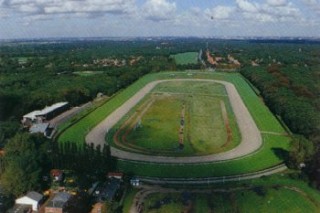
situated near
the horse
racing track
behind the
estate
property,
where trees
and buildings
offered
concealment.
The launching
site at
Beukenhorst
was still in
use, as were
sites near the
Promenade
Hotel at
Scheveningseweg,
and also in
the Haagse
Bos. These
firing sites
had to be wide
enough for
tanker
vehicles to
maneuver and
easily fill
the V-2
propellant
tanks, a
process that
was both
hazardous and
time-consuming.
The
Resistance
undoubtedly
played a
significant
role in
providing the
RAF with a
wealth of
information
regarding
various
launching
sites, convoy
movements, and
firing
schedules.
This
intelligence
was a key
factor behind
the decision
to rotate
launch sites
frequently.
The purpose
was to keep
Allied pilots
in a state of
uncertainty
and guessing
about where
the next
launch might
occur. By
continually
changing the
locations, the
Germans
effectively
disrupted the
RAF's response
strategies,
reduced the
chances of
successful air
attacks, and
prolonged the
operational
life of the
missile
campaign.
-
RIJSWIJK MONUMENT TO PEACE PRIOR TO THE
WAR
On
October 26, a
new launch
record was
achieved by
the two
platoons of
Battery 444. A
total of nine
rockets were
fired from the
sites at
Wassenaar and
Rijswijk,
three within
25 minutes of
each other.
The following
day, October
27, the
results were
not so good.
Around 2:00
PM, from the
firing site at
Beukenhorst,
Battery 444
launched a
rocket that
climbed
steadily to a
height of
about 280 feet
before the
engine
abruptly shut
down. The
rocket fell
back almost
directly on
the launching
point, coming
down on the
border of
Beukenhorst
and
Wittenburg.
Twelve
soldiers were
killed and
much of their
equipment was
destroyed or
badly damaged.
The blast
shattered roof
tiles and
windows within
a 600-meter
radius. As a
result,
Beukenhorst
was abandoned,
and the firing
troops moved
to the
Langenhorst
estate
starting on
November 4.
Two
hours later,
as young Rita
Winter walked
with her two
little nieces
down a street
near her home;
she heard the
start of
another V-2.
This one rose
straight up
from Rijswijk,
and then the
engine began
to stammer.
The rocket
oscillated
back and forth
before
crashing to
earth. The
girls ducked
into the
window bay of
a store front.
The rocket
came down
about three
quarters of a
mile away at
Van
Vredeburgerweg
and ripped a
fifteen-meter
wide crater in
the meadow
opposite the
boys school
House of the
Crusaders of
St. John in
the park
Nieuwvoorde
near
Wateringen.
The main
building was
destroyed,
while the
other
buildings of
the Roman
Catholic boys
institute were
severely
damaged. Seven
boys and five
brothers in
the ages
between nine
and
twenty-eight
were killed
instantly and
five were
seriously
injured, two
died later.
The following
day, the
Rijswijk and
Beukenhorst
launch sites
were
abandoned. It
had not been a
good day for
Battery 444 it
had been just
as bad for the
Dutch
residents.
-
With the V-2
attacks
underway, the
German concept
for mobile
rocket
operations was
put to the
test. The idea
was to keep
the logistics
as simple as
possible,
which was
difficult
considering
that there
would be
hundreds of
troops and
specialized
vehicles
involved, not
to mention
complicated
supply issues.
A typical
trailer-mounted
rocket was
supported by
about 30
vehicles,
which included
a transport
trailer,
mobile crane,
launch table
and trailer,
propellant
vehicles, and
command and
control
trucks.
The
rockets and
warheads,
along with the
liquid-oxygen
and alcohol,
would be
delivered to
the firing
areas by
railway. The
deployment of
the missiles
to the mobile
firing sites
was certainly
not an easy
task, but it
was a task
that the
Germans
performed
quite
efficiently.
One of the
biggest
challenges was
the
coordination
of the
multitude of
troops that
were required.
-
V-2 MATERIAL FOUND IN THE WATERS OF
CASTLE WITTENBURG IN WASSENAAR
-
The basic
organization
of a V-2
battery in The
Hague was very
much like a
traditional
German
motorized
artillery
unit. It
consisted of
five primary
sections,
along with
various other
units. All
battery
personnel
carried the
usual combat
weapons of
normal
Wehrmacht
units, along
with the
specific
equipment
associated
with their
duties. The
headquarters
section
maintained the
battery troop
headquarters.
The staff was
under the
direction of
the unit
commander. It
was
responsible
for general
military
administration,
recording all
the operations
of the unit,
communication,
and for range
calculations
and map
plotting.
The launching
section troops
were split
into three
individual
firing
platoons, each
with its own
Feuerleitpanzer
firing control
vehicle and
launching
table. In most
situations,
there were
three
Meillerwagens
for each
platoon nine
Meillerwagens
per battery.
Each firing
platoon
contained
around 39 men,
all with a
specific duty
to perform
during the
execution of
certain
routine tests
in the
preparation of
the rocket.
Platoons
included the
fire control
crew with the
Feuerleitpanzer,
along with the
surveying and
adjustment
crew, which
were
responsible
for the final
survey of the
launch site
and for the
actual
alignment of
the rocket
before firing.
The engine
crew,
electrical
crew, and the
vehicle crew
operated the
Meillerwagen
and firing
table.
The radio
control
section
operated the
Brennschluss
antenna
arrays, placed
at a
calculated
distance
several miles
behind the
firing point. The
fuel and
supply section
consisted of
four companies
responsible
for unloading
the rockets
and rocket
fuels from the
railhead. At
Leiden, the
first company
of the supply
detachment
would
transport the
missiles to
the field
store. They
used about
three
Vidalwagen
road transport
trailers for
each
Meillerwagen,
making
approximately
27 Vidalwagens
per battery.
The warheads
were loaded
onto trucks
and brought
separately to
the field
store. The
second and
third
companies of
the supply
detachment
delivered
rocket fuels,
while the
fourth company
provided
gasoline and
oil for
battery
vehicles. The
technical
section
consisted of
technicians
that manned
the field
stores, tested
vital components,
and if
necessary,
repaired any
possible
defects on the
rockets. The
technical
troops would
then prepare
the rockets,
with warheads
attached, for
the firing
platoons.
Additional
units included
a maintenance
platoon, which
maintained the
motorized
transport
vehicles and
other
mechanical
equipment. The
telephone
section
operated the
communications
between the
sections and
with the
battalion
headquarters.
The camouflage
section was
responsible
for creating
camouflage
arrangements
around the
firing
positions, and
a
fire-fighting
platoon was on
hand if
needed.
Originally, a
security
platoon
protected the
areas
surrounding
and within the
firing range,
and the V-2
positions were
supported by
designated
flak units,
but following
January 1945,
the security
troops, along
with the flak
units, were
separated from
their original
organization.
They
subsequently
became a part
of the much
larger defense
zone that was
established
around The
Hague,
integrating
their efforts
into the
broader
military
framework and
enhancing the
overall
defensive
strategy of
the city.
MEMORY SKETCH MADE BY
STUDENT BILL WILS OF ROCKET TRANSPORT IN
THE HAGUE
The technical
section
consisted of
technicians
that manned
the field
stores, tested
vital components,
and if
necessary,
repaired any
possible
defects on the
rockets. The
technical
troops would
then prepare
the rockets,
with warheads
attached, for
the firing
platoons. Additional
units included
a maintenance
platoon, which
maintained the
motorized
transport
vehicles and
other
mechanical
equipment. The
telephone
section
operated the
communications
between the
sections and
with the
battalion
headquarters.
The
camouflage
section was
responsible
for creating
camouflage
arrangements
around the
firing
positions, and
a
fire-fighting
platoon was on
hand if
needed.
Originally, a
security
platoon
protected the
areas
surrounding
and within the
firing range,
and the V-2
positions were
supported by
designated
flak units,
but after
January of
1945 the
security
troops and
flak units
were no longer
attached to
the
organization
and became
part of the
greater
defense zone
of The Hague.
PHOTOS
BELOW:
STRAATSSPOOR
STATION AND
SCENES OF
OCCUPATION
DURING THE V-2
CAMPAIGN IN
THE HAGUE
-
LEIDEN
The
rockets coming
by railway
from Germany
were offloaded
at Leiden,
north of The
Hague. The
rail tankers
carrying
rocket fuels
continued
south into The
Hague. The
offloading of
liquid-oxygen
and the other
propellants
took place
immediately
after the
arrival of the
train at the Staatsspoor
station
near the
Emmakliniek
(Schenkweg)
and at a
sideline of
the
Hollandsspoor
station behind
Zwetstraat.
Eventually,
because of
changing
logistics or
RAF bombing
damage, other
offloading
points were
used. A
complete list
of fuels
needed for a
launch would
be as follows:
A-Stoff =
liquid-oxygen;
B-Stoff =
alcohol
consisting of:
45% ethanol,
30% methanol +
25% water
(H2O), along
with 175 kg
hydrogen
peroxide and
13 kg
potassium
permanganate,
to generate
steam for the
fuel pump.
Waiting at the
station were
the trucks and
bowsers of the
fueling teams.
From the
Abstellpark
(fuel storage
area), an
average of
eight
Betriebstoffanhanger
(liquid-oxygen
bowser
trailers),
four
Flugbetriebstoff-Kesselwagen
(alcohol
tanker
trucks), and
several other
various types
of trailers
were readied
for fueling
operations.
The fuels were
transferred
under the
station canopy
very quickly
in order to
prevent
evaporation
loss. The
liquid-oxygen
was then
hurried to the
firing
positions.
Tractors and
trailers with
the ice on the
tanks were
seen speeding
through the
streets of The
Hague for
months. The
city of The
Hague was the
terminus of a
direct railway
line coming
from Germany.
These railways
were extremely
important to
the Germans.
Not only was
it the fastest
way to move
troops, arms,
and supplies,
it was also
the means by
which forced
laborers and
Jews were
moved to the
east. The
dense Dutch
railway
network was
still largely
intact in 1944
and was
crucial to the
German
V-weapons
deployment.
The Dutch
railways were
fully
integrated
into the
German lines
from the east
in order to
make the
transport of
weapons as
easy as
possible.
The V-2s
arrived under
the cover of
darkness at
the Leiden
Centraal
Station over
the line from
Utrecht or by
the line from
Amsterdam-Haarlem.
Leaving
Friedrichshaven,
a V-2 train
took
approximately
35 hours to
reach Leiden.
The main entry
points from
Germany were
Enschede,
Oldenzaal, and
Winschoten in
the north,
going through
the important
transit
stations at
Deventer,
Zutfen,
Apeldoorn,
Amersfoort,
and Utrecht,
the main line
from the west.
In the woods
near the Dutch
town of Ommen
the Germans
laid out two
new
camouflaged
railway
sidings. Each
siding was
approximately
one kilometer
long and
diverged to
the south side
of the main
railway line.
Bound for the
launching
sites in the
western part
of the
Netherlands,
the trains
loaded with
V-2s stayed
there during
the day, sheltered
by the long
roof of the
main station,
for protection
from the RAF.
-
PERIOD MAP OF LEIDEN SHOWING ROAD AND
RAIL NETWORK -
-
FOOTAGE
FROM ALLIED FOOD DROPS OVER LEIDEN IN
1945 SHOWS PIONIERSPARK AT STATION
HEERENSINGEL
V-2 TRANSPORT ROUTES THROUGH LEIDEN
Depending on
the arrival
time that
night or the
following
night the
train would be
moved a few
kilometers
over a
connecting
line to the
cargo
offloading
station at
Heerensingel,
which was on
the other side
of Leiden near
the canals of
the old city.
Next to
Station
Heerensingel
was the
engineer s
installation
called
Pionierspark.
Many rockets
and rocket
parts were
always at
Pionierspark,
as the
wreckage from
crashed V-2s
was also
returned to
this location.
On the siding
at
Pionierspark,
the giant
mobile crane
straddled the
track while
the rockets
were lifted
from the
flatcars and
laid onto the
Vidalwagen
road transport
trailers. Each
train carried
20 rockets,
and it took a
little over
one hour for
the engineers
to finish the
offloading.
Before the
light of
morning, the
road transport
vehicles would
take the
rockets away.
Personnel of
the
Umschlagtrupps,
consisting of
a crane troop
and offloading
crew, carried
out the
transfer of
the rockets
from the
railway wagon
to the
Vidalwagen.
The
Kraftfahr-Abteilung
900
transported
the rockets to
the
intermediate
storage
facility. The
rocket
warheads were
carried on the
same train,
but they were
not attached
to the
rockets. They
were offloaded
separately. A
special
detachment of
German guards
watched over
the V-2 rail
cars at
all times. The
Group North
flak train was
positioned
near Leiden
Centraal
Station with
its six
heavily armed
anti-aircraft
rail
cars.
The rockets
were towed
from Leiden on
Vidalwagen
road transport
trailers to
the technical
troop s field
store near the
launching
areas. In the
early period,
the
projectiles
were
transported
directly to
the
intermediate
storage
facility at
Raaphorst and
ter Horst.
Later, the
rockets were
also stored on
the site of
the Marine
Zeugamt
(marine
arsenal) at
Maaldrift
(near
Wassenaar) and
under the
canopy of the
Haagse Bos.
From both
locations, the
projectiles
were driven to
the Technical
Battery.
Early
in the
campaign, the
technical
troop
installed
itself in the
lush park of
the De
Wittenburg
estate in
Wassenaar,
while a car
park and
repair shop
had been
installed
nearby on the
dairy farm at
Rust en
Vreugd. Later,
the technical
troops moved
to the studio
halls of the
Filmstad on
the Oosterbeek
estate. Small
stockpiles of
rockets were
always kept at
the field
store of the
technical
troops, to be
able to
deliver a few
specimens
immediately
when the order
was given.
Here the
warheads were
attached to
the nose of
the rockets,
and there was
an opportunity
for a final
check of the
instruments.
The rockets
were towed
from Leiden on
Vidalwagen
road transport
trailers to
the technical
troop s field
store near the
launching
areas. In the
early period,
the
projectiles
were
transported
directly to
the
intermediate
storage
facility at
Raaphorst and
ter Horst.
Later, the
rockets were
also stored on
the site of
the Marine
Zeugamt
(marine
arsenal) at
Maaldrift
(near
Wassenaar) and
also under the
canopy of the
Haagse Bos.
From both
locations, the
projectiles
were driven to
the Technical
Battery. Early
in the
campaign, the
technical
troop
installed
itself in the
lush park of
the De Wittenburg estate in Wassenaar, while a
car park and
repair shop
had been
installed
nearby on the
dairy farm at
Rust en
Vreugd. Later,
the technical
troops moved
to the studio
halls of the
Filmstad on
the Oosterbeek
estate. Small
stockpiles of
rockets were
always kept at
the field
store of the
technical
troops, to be
able to
deliver a few
specimens
immediately
when the order
was given.
Here the
warheads were
attached to
the nose of
the rockets,
and there was
an opportunity
for a final
check of the
instruments.
-
ANTI-TANK DITCH CONSTRUCTION CUT THROUGH
THE HAAGSE BOS
-
THE HAAGSE BOS (THE HAGUE FOREST) WAS
INTEGRATED INTO THE DEFENSIVE
FORTIFICATIONS AND V-2 OPERATIONS
The V-2 s main
strength was
its mobility,
as it was not
tethered to
any fixed
launching
points. To
stabilize and
launch the
missile all
that was
needed was a
firm surface,
such as an
asphalt or
concrete road,
or firm sandy
ground.
However, under
the blast of
the rocket s
exhaust, old
cobblestone
roads would
disintegrate,
flinging
stones in all
directions.
During
inclimate or
soggy weather,
the crews
sometimes used
steel sleepers
underneath the
firing table
for added
stability.
Despite the
fact that
well-established
launch sites
were already
known to the
RAF, crews
preferred
places with
tall trees and
returned to
them over and
over again. A
tree-lined
street, such
as
Rijksstraatweg-Benoordenhoutseweg,
which runs
north from Den
Haag through
Wassenaar, was
the ideal
launching
site. It was
firm and
level,
accessible to
all launch
vehicles, and
the tall trees
provided
natural
camouflage for
the 46-foot
high rockets.
The Haagse Bos
(Hague Forest)
was a large
forested city
park in dating
back before
the middle
ages. It is
one of the
oldest oak
forests in the
Netherlands.
The primeval
forest
originally
stretched from
Hoek van
Holland in
south all the
way to Alkmaar
in the north.
Previously
covering the
entire area,
the forest was
known then as
Houtland,
but by
twentieth
century, only
the Haagse Bos
remained. Over
the centuries,
the forest was
gradually
reduced as the
population
grew, until it
was protected
by officials
as a local
hunting and
recreational
area. Located
inside the
defensive
fortifications
of the
Scheveningen
and
Clingendael,
the forest
extended a
little less
than 2 miles
and was about
500 yards
wide, with its
longest sides
bordered by
the main roads
Benoordenhoutseweg
and
Bezuidenhoutseweg.
On the south
side a large
portion of the
forest had
been cleared a
few years
earlier when
an anti-tank
ditch was
scoured out
through the
city. A
small portion
of the
anti-tank wall
and ditch
remains today
at the
intersection
of t Hoenstraat and S102.
Through
the length of
the forest was
the
cobblestone
street
Leidsestraatweg,
which gave
easy access
for the rocket
troop vehicles
to all parts
of the forest.
Located on the
eastern end of
the woods was
the Paleis
Huis Ten
Bosch, which
would later
become the
official
residence of
the
Netherlands
royal family
in 1981. Even
though the
opulent
building
survived the
war, it
suffered
damaged from
the V-2
offensive.
At the end of
October,
Battery 2./485
was withdrawn
from The Hague
and sent back
to
Burgsteinfurt
in Germany.
Their new task
was to support
the firings on
Antwerp.
Operating from
launch sites
near Heek, the
crews of
2./485 were
supposed to
begin tests to
improve the
V-2 s accuracy
by using the
new Leitstrahl
(guidance beam
system). This
meant for a
number of
weeks, only
Battery 444 s
platoons
remained in
The Hague to
fire against
London.
Battery 1./485
would
eventually
travel from
Germany to
join Battery
444, but
wouldn t
arrive until
mid-December.
On
November 1,
1944, the
first rockets
were fired
from the heart
of the city.
Until that
moment, the
firing crews
had operated
in the
surrounding
suburbs, just
on the
outskirts of
The Hague. The
new firing
locations were
located in a
strip near the
Oude
Scheveningseweg
and
Stadhouderslaan,
a part of The
Hague cleared
previously for
the defenses
of the
St tzpunktgruppe
Scheveningen.
A portion of
the
Scheveningse
Bosjes trees
were cut down,
large villas
had been
demolished,
leaving only
the
Gemeentemuseum.
The launch
sites were
situated on
the road of
Kerkhoflaan,
and at the
junction
Willem de
Zwijgerlaan
and Antonie
Duyckstraat.
The old hotel
Promenade on
the Oude
Scheveningseweg
served as V-2
storage for a
short period.
On November 5,
a fierce
southwestern
storm broke
out over The
Hague and got
worse over the
next several
days. The
launches were
halted. As
soon as the
weather
cleared, on
November 10,
eight missiles
were launched
from Duindigt
and Oude
Scheveningseweg.
One of the
V-2s that
evening
malfunctioned
and flew
backwards and
crashed near
the road to
Duivenvoorde
castle.
In
November, a
new detachment
was sent to
The Hague:
Artillerie
Ersatz
Abteilung 271
(Artillery
Replacement
Detachment
271).
Detachment 271
was originally
formed to act
as a buffer
for the
operational
V-2 units.
Throughout the
greater part
of 1944, they
were
responsible
for training
the new
recruits in
V-2 field
operations,
while at the
same time;
their members
were available
to supplement
the existing
operational
units. In
November,
Detachment 271
was
incorporated
into Battery
444, its
additional
members
helping
finally to
bring the unit
to full
strength.
Battery 444
now comprised
three
operational
firing
platoons, a
technical
troop section,
a fueling
section, and a
target
acquisition
and radio
section.
Ever since
arriving in
The Hague, the
soldiers of
Battery 444
had been
waiting for
their promised
third platoon
to arrive, but
the third
platoon was
slightly
different from
other
platoons. The
personel of
the first
platoons were
the
highly-trained
and
highly-experienced
specialists of
the original
Lehr- und
Versuchsbatterie.
The third
platoon
consisted
mostly of men
only trained
recently with
very little
practical
experience in
operations.
They hurriedly
completed
their training
in K slin and
fired some of
the last
training shots
from
Heidekraut.
While waiting
for their
vehicles and
equipment,
they spent
time in the
Baumholder
camp near
Trier, then
helped the
farmers in
Westerwald
with the
harvesting of
potatoes and
killed more
time with some
infantry
exercises.
The
third platoon
of Battery
444, under the
command of
Oberwachtmeister
Haarnagel,
arrived at Staatsspoor
station
at about 9:30
in the morning
on November
15. They were
taken to new
quarters at
Marlot, and
then were sent
out
immediately to
fire a rocket.
With the
addition of
the third
platoon, the
situation for
Battery 444
rocket crews
in The Hague
and Wassenaar
had not really
changed with
the addition
of the third
platoon. All
three platoons
supported each
other, but
essentially
the first two
platoons of
444 operated
in the same
manner as
before.
THE HAAGSE BOS AND
LEIDSESTRAATWEG EXPLORED 2010, 2019,
IV2RG
HOEK
VAN HOLLAND
New launching
sites were
chosen at Hoek
van Holland,
at the edge of
the Nieuwe
Waterweg, near
the lighthouse
on a new
concrete road
a few hundred
yards east of
the railway
station,
opposite the
Rozenburg-Hoek
of Holland
ferry. Located
about ten
miles south of
The Hague, the
site offered
few camouflage
opportunities,
so starting on
November 15,
1944, the V-2s
were almost
exclusively
launched under
the protection
of darkness.
After each
launch,
perfect little
squares were
scorched into
the fruit
wharf and new
concrete road
where the
firing tables
had been
standing
southeast of
the station.
-
Not far away
there was
another launch
site in the
Staelduinse
Bos (at
Achterlaan
road). The
Staelduin
Forest was a
wooded area on
the edge of
the polder,
north of the
defensive
fortress of
Hoek of
Holland.
Located a safe
distance from
the coast, the
area was
already
sprinkled with
bunkers and
ammunition
mazazines.
After the
residents of
nearby farms
had been
rousted from
their property
the day
before, the
first launch
from Staelduin
occurred on
November 13,
1944. There
were three
launch sites
in the western
portion of the
forest, but
after only a
few days,
heavy rainfall
made the
forest floor
unstable. This
forced the
rocket crews
to use the
concrete road
and fruit
wharf areas
for the time
being. Over
the next
months, the
first and
second
platoons of
444 occupied
these sites
alternately;
later the
crews of 485
would use the
site.
Since November
9, German
armies no
longer
occupied
Walcheren.
After a sharp
nine-day
battle, the
German
commander
surrendered
Walcheren and
10,000 German
troops to the
British and
Canadian
forces. The
water route to
the port of
Antwerp was
now clear;
Allied forces
controlled all
fifty-four
miles of the
port s seaward
approaches.
However, the
rocket
launchings
went on from
The Hague and
its outskirts.
-
-
-
PHOTOS ABOVE SHOW THE DEFENSES OF HOEK
VAN HOLLAND
On a clear day
in the
northern
portions of
the Antwerp
suburbs,
soldiers and
civilians
could see the
rockets
heading for
London from
the Dutch
coast. During
the month of
October, 83
rockets had
been launched,
of which five
were failures.
Some rockets
blew up on
their launch
stands,
killing and
injuring crew
members; some
failed to
ignite at all;
others hung in
the air for a
moment, then
crashed to
earth and blew
up or fell
into the sea.
Whenever Dutch
civilians
heard the roar
of ignition,
everyone would
begin to count
the seconds.
After 30
seconds, they
were safe. If
the engine
stopped after
30 seconds,
the rocket
would crash
into either
the North Sea
or fall
somewhere
outside the
city. However,
if the roar
stopped prior
to 30 seconds,
the missiles
would fall
back onto the
neighborhoods
of The Hague.
-
In Voorburg at
Koning
Wilhelminastraat,
a V-2
destroyed six
houses, while
another rocket
came down on
the railway
station in
Wassenaar.
Residents in
the city
watched a
rocket looping
over a meadow,
its engine
kicking off
and on, with
German
soldiers
chasing after
it. It finally
hit the ground
and blew up.
Most of the
rockets
exploded on
impact. If the
warhead did
not go off,
German
specialists
would try to
defuse it. The
detonation of
the
2,000-pound
warhead, along
with the
eruption of
alcohol and
liquid-oxygen,
damaged
hundreds of
houses and
caused many
civilian
casualties.
Dutch
intelligence
put the
failure rate
at about eight
percent. Many
of the rocket
crew reports
coming to
division
headquarters
sounded
similar:
Battery
1./485, Serial
No. 18374,
September 22,
1944, 04:45
hours; thrust
terminated
shortly after
liftoff,
unknown
reasons.
Device fell
back on firing
table and
exploded.
Cause not
determined.
Battery 444,
Serial No.
18979,
September 30,
1944, 15:50
hours; after a
series of
standard
checkups, the
rocket was
prepared and
fired as
usual. At an
altitude of
approximately
219 meters,
there was an
explosion in
the midsection
of the tail
unit, which
terminated the
thrust. The
rocket crashed
about 20
meters from
the firing
table. The
fuel tanks
exploded, the
warhead
simmered in
the burning
alcohol for 45
minutes before
detonating.
Battery 444,
Serial No.
18951, October
7, 1944;
Rocket was
returned to
field store
after
preflight
tests revealed
problem with
tail fin
rudder. After
inspection of
the fin, the
error was not
clearly
ascertained.
Error is
probably in
trim motor.
Since
investigation
requires the
removal of the
tail section,
the device was
returned.
Although the
launching
batteries in
The Hague hit
London 82
times in
November, the
crews of
Battery 444
and Battalion
485 had no
real idea
where their
missiles were
striking. They
could only set
the gyro
mechanisms and
hope they were
accurate.
Several
unsuccessful
attempts were
made to
pinpoint the
V-2 impacts by
using radio
waves and
seismology;
however, in
the end, the
best reports
came from
German spies,
but even those
reports were
suspect, as
British
Intelligence
had turned
many of the
spies around.
Rockets
frequently
broke up in
the upper
atmosphere,
high above the
North Sea. On
November 12, a
rocket broke
up over
London s
Victoria
Station.
Astonished
people saw a
puff of smoke
bloom in the
sky, followed
a few seconds
later by a
distant
explosion and
a hail of
metal
fragments.
On the dismal
evening of
November 11, a
V-2 came down
near Shooters
Hill in
Greenwich,
creating a
ghastly scene.
Striking a
road that was
filled with
commuters, it
left a massive
hole in the
roadway and
consumed
everything in
its path. The
passengers on
a city bus
were set
ablaze when
the flash
ripped off the
top deck and
fire engulfed
the remainder
of the
vehicle.
Across the
street, a
local pub
collapsed,
crushing and
then
incinerating
all of the
customers
inside. Unlike
the V-1, the
V-2 blast
effect had a
tendency to
set on fire
everything in
the immediate
area. Ruptured
gas mains
unleashed
tremendous
bluish flames
that shot high
into the air,
creating a
fiery
spectacle
reminiscent of
a scene from
Dante s
Inferno. The
sight was both
awe-inspiring
and terrifying.
During the
first week of
November, 12
V-2s hit
London; during
the second
week, 35 V-2s
came down;
during the
third week,
there were 27
V-2 incidents.
Rockets had
been spotted
underneath the
trees in the
Haagse Bos,
Willem de
Zwijgerlaan,
Zorgvliet,
Kerkhoflaan,
Langenhorst,
and
Waalsdorperweg.
When the first
few rockets
landed on
England in
September,
they had been
little more
than a
nuisance. By
November 14,
there were
about four V-2
incidents per
day. As of
November 20,
about 210
rockets had
reached
England, with
95 hitting
London. 456
people had
been killed in
London alone,
with hundreds
more injured.
The
improvement in
performance
was largely
because the
launching
crews were now
getting a
better grade
of missile.
Under a new
supply system
called Warme
Semmel, or
hot cakes,
rockets no
longer sat in
storage for
weeks at a
time before
launching. It
was hoped that
by firing the
rockets
quickly only a
few days after
coming off the
assembly
lines the
deterioration
of vital parts
would be
prevented,
thus reducing
the number of
failures.
Furthermore,
all sensitive
components
were fitted
into the
missile s body
at the last
minute. This
made the work
at the
technical
troop s field
store
considerably
more
important.
After final
assemblies and
tests were
completed, the
missile was
turned over to
the launching
platoons.
At General
Dornberger's
headquarters
in Schwedt,
the
transportation
office planned
the fastest
routes for
moving the
rockets from
the Mittelwerk
directly to
the front. In
order to
discover other
potential
problems,
Dornberger s
staff sent
technical
experts from
Peenem nde to
the launching
areas to
inspect and
supervise the
transport,
handling, and
delivery
practices in
the field.
These
technical
crews
maintained a
supply of
spare parts
and introduced
new components
for the
missiles.
After a number
of
corrections,
the overall
rate of
failures was
reduced.
On November
25, 1944,
while a V-2
was being
feuled in
Wassenaar,
people all
over London
were enjoying
a nice
shopping day.
In West End,
American
soldiers could
be spotted
among those
enjoying the
day. In the
East London
district of
Deptford, at
the New Cross
Shopping
Center, it was
as crowded as
ever on that
Saturday
afternoon.
Shoppers were
packed into
Woolworth s
department
store, busy
choosing from
the store
shelves. At
12:10 PM,
following a
blinding
flash, the Woolworth s building
was shaken
apart by a
massive
explosion. An
instant later,
the entire
building
collapsed into
the basement.
Everyone
inside was
thrown down
into the
cellar along
with tons of
beams and
plaster; many
were buried
under the huge
pile of debris
as bits of
material
continued to
flutter from
the sky. 171
people were
killed, 108
seriously
injured. Bits
of people were
strewn around
the rubble.
Some were
killed
outright by
the rocket s
impact; others
were crushed
or suffocated
when the
building caved
in. Nearby
there was
again a city
bus, its
windows and
tires
shattered,
with rows and
rows of people
all covered in
dust and
sitting very
still and very
dead. Seventy
bodies were
pulled out of
Woolworth s
alone. Eleven
souls were
never found.
It would later
be known as
the single
worst V-2
incident in
London.
High-flying
Allied bomber
crews were
viewing this
daily
onslaught of
V-2s rocketing
skyward
towards
England. On
November 24,
the 544th Bomb
Squadron of
the 384th Bomb
Group, while
flying at
22,000 feet,
got a close
look at the
rockets. The
B-17 and B-24
crews could
easily see the
fast-moving
missiles and
their
contrails
against the
blackness of
the upper
atmosphere.
When the
number of V-2
incidents
began to
increase, the
London
population
called on
officials to
take action to
stop the
attacks. As
well as
causing
physical
damage, the
rockets highly
affected
Londoners
psychologically.
When compared
to the V-1
flying bomb,
the rocket
impacts seemed
almost
supernatural.
Since there
was no time to
do anything,
the number
killed and
injured by the
missiles was
predictably
high. A
lightning
bolt out of
nowhere,
followed by
the
overwhelming
rush of air
and ominous
howl of the
incoming
missile. V-2s
came
unannounced,
so most people
just went to
bed at night
and prayed
that they
would be there
the next
morning. After
hearing the
bang, people
could often
see where the
rocket had
fallen by a
column of
smoke that
would rise and
hang in the
air as little
bits were
fluttering
down. On
average of
four people
died, which
was double the
death rate of
the Flying
Bombs.
In spite of
the V-2 s
reputation, it
caused less
disruption to
daily life
than the V-1
because there
was no way to
prepare for
it. There was
no warning of
an impending
impact.
Victims were
vaporized
without their
knowledge.
Owing to its
impact speed,
the V-2 would
burrow 30 feet
into the
ground before
the warhead
could explode,
and the blast
wave would
annihilate
everything
within a
quarter mile
radius. The
lateral blast
damage was not
as great as
the V-1, but
later it was
discovered
that many
buildings that
were thought
to be intact
had actually
sustained
substantial
structural or
foundation
damage caused
by the
shockwave of
impact.
-
WOOLWORTHS INCIDENT NOV. 25, 1944
RAF
COUNTER-MEASURES
The
RAF s Second
Tactical Air
Force and
Fighter
Command began
reconnaissance
and strafing
attacks on the
Dutch railways
almost as soon
as the rockets
began falling
on London.
Initially, the
attacks proved
fruitless.
However, after
bombing the
vital arteries
at Enschede,
Almelo,
Amersfoort,
Utrecht, and
Leiden and
bridges at
several river
crossings, the
RAF was able
to disrupt the
transports to
a certain
extent.
Nonetheless,
the Germans
managed to
repair the
lines very
quickly, even
though the
damage was at
times
considerable.
The pilots of
the RAF,
namely No. 229
Squadron RAF,
had been in
operations
against V-2
targets since
September 10,
1944. On
October 7, the
legendary
Polish 303
Squadron
joined in the
ground attack
missions
against Big
Ben targets.
Flying out of
Coltishall, No. 602 Squadron RAF was brought
in to patrol
for V-2s on
October 10.
Also in
October, No. 453 Squadron RAAF (Royal Australian Air
Force), and
later No. 451
Squadron RAAF,
began
practicing
dive-bombing
techniques
from their
base at
Matlask.
In
November, the
No. 453
Squadron was
transferred to
Swannington
and equipped
with new
clipped-wing
Spitfire Mk.
XVIs. From
November 1944
to March 1945,
No. 453
Squadron was
heavily
engaged in
striking at
assembly and
launch sites
of the V-2. A
typical day
for the
Spitfire
pilots started
with an early
weather
reconnaissance
flight over
the Channel to
the Dutch
coastline to
determine
which targets
would be
suitable for
that day. The
squadrons
would form up
over England
and head east
toward The
Netherlands.
As they neared
the target
areas, the
Spitfires
would descend
to attack
altitude,
somewhere
between 8,000
to 5,000 feet,
and in echelon
formation,
they would
make their
final approach
to the target. A
typical day
for the
Spitfire
pilots started
with an early
weather
reconnaissance
flight over
the Channel to
the Dutch
coastline to
determine
which targets
would be
suitable for
that day. The
squadrons
would form up
over England
and head east
toward The
Netherlands.
As they neared
the target
areas, the
Spitfires
would descend
to attack
altitude,
somewhere
between 8,000
to 5,000 feet,
and in echelon
formation,
they would
make their
final approach
to the target.
One method of
attack was to
fly in echelon
over the
target until
it passed out
of sight below
the wing, then
the Spitfires
would roll in
and trim the
aircraft into
a sheer dive.
The bombs were
released at
around 3,000
feet, which
gave the
pilots enough
time to
recover from
the momentary
blackout
caused by the
g-forces as
they pulled
out of the
dive. They
would then be
required to
make their
low-level
escape,
avoiding the
anti-aircraft
guns in the
process.
The rocket
troops would
be attacked by
the RAF on
many
occasions,
although
generally, not
much damage
was inflicted
on the battery
itself, as was
the
surrounding
infrastructure.
The main
targets in The
Hague were De
Wittenburg,
Duindigt, the
Haagse Bos,
Ockenburgh and
Bloemendaal,
as well as the
main road
leading from
The Hague to
Leiden.
-
- PHOTOS ABOVE: BIG BEN
OPERATIONS 1944-45, NO. 602 SQDN. RAF,
NO.. 453
SQDN. RAAF
"CLIPPED-WING"
SUPERMARINE SPITFIRE MARK XVI
The rocket
trains from
the east
carried
mounted
anti-aircraft
guns onboard,
while the
battery road
transport
units in
Leiden and The
Hague were
protected by
mobile
half-tracks
carrying 3.7
cm
anti-aircraft
flak guns.
Additional
anti-aircraft
guns were
positioned in
defenses of
the Atlantic
Wall.
Nevertheless,
the RAF
attacks were
conducted at
extreme
speeds, right
through the
hail of
anti-aircraft
fire. After
dropping their
bombs, they
strafed other
targets and
then took off,
disappearing
just as fast
as they had
arrived. These
days were
exhausting for
the RAF
pilots. During
clear weather,
a single
squadron could
mount many
sorties per
day.
Besides
attacking the
launching
sites, the
large railway
junctions to
the east were
bombed daily
in an attempt
to destroy the
V-2 supply
lines.
However, the
lines were
repaired
rapidly by the
thousands of
forced
laborers
employed by
the Germans.
Even though
the RAF slowed
deliveries,
the trains
with rockets
and fuels
continued to
make it
through to The
Hague.
On
November 17,
1944, the Air
Ministry
released a
report
describing the
operations of
Fighter
Command
against V-2s.
The report was
not
encouraging.
The worsening
weather was
hampering
ground
attacks. When
not grounding
aircraft, it
obscured the
target areas.
Furthermore,
the
requirement
not to risk
Dutch civilian
casualties was
prohibiting
operations in
built up
areas.
Meanwhile,
Londoners were
suffering from
the rocket
attacks, so
the report
requested this
restriction be
reconsidered.
Following
the report,
Allied air
forces
increased
reconnaissance
flights over
The Hague,
conducting
hundreds of
sorties to
locate
V-weapon
targets, with
frequent tips
from the Dutch
underground.
Members
of the Dutch
Resistance
learned very
quickly that
if a
Meillerwagen
trailer
arrived in the
area, along
with the rest
of the
battery s
vehicles, it
was the sure
sign of an
impending
launch. The
rocket troops
knew the
underground
was watching,
because the
fighter-bombers
came soon
after each
round was
fired to
attack the
German
positions. All
along the
Rijksstraatweg,
the road north
from The Hague
through
Wassenaar,
foxholes had
been dug for
quick shelter
in case of air
attack. At one
place along
the road, a
large sign
informed
pedestrians
Attention!
Strafing
attacks;
foxholes on
left. Dutch
civilians were
even subject
to attack if
they were in
the wrong
place at the
wrong time.
Soon the
rocket crews
realized that
the launch
vehicles were
giving away
their
intentions. In
December, a
camouflage
platoon was
added to each
firing
platoon. Field
training now
emphasized
camouflage for
concealing the
tankers and
trailers from
the air.
Vehicles that
remained in
the launching
areas were dug
in and covered
with
concealment
netting; the
rest were
dispersed and
hidden in the
woods.
Between
October and
November, the
U.S. Army Air
Force and
Fighter
Command flew
more than ten
thousand
sorties
against
railways and
road
transportations,
between Den
Haag and
Leiden, and
around the
Hoek van
Holland.
Fighter
Command flew
600 more from
British
airfields,
much of the
work done by
the Spitfire,
employed as a
fighter-bomber.
Allied
fighters
caught two
trains just
from the
Central Works
factory at the
end of
November. The
trains carried
40 missiles
between them -
all 40 rockets
were scrapped.
As
early as
September,
British
intelligence
was informed
of the
offloading
stations in
Leiden Station
Heerensingel
and the Leiden
Centraal
Station.
However, the
Bombing
Commission in
London was
ignorant of
the actual
logistical
situations of
the enemy and
often
consulted the
reports from
the Dutch
Resistance.
Because of the
risk to Dutch
lives and
property, the
Resistance
urged attacks
on railways
exclusively.
In a meeting
on November
21, 1944,
representatives
of the Dutch
government,
met with
Fighter
Command s Air
Marshal Hill
and other Air
Ministry
figures. The
result of the
meeting was a
general
agreement for
increased
efforts
against the
V-2, along
with the
loosening of
the severe
attack
standards over
the
Netherlands.
Fighter
Command would
now be allowed
to attack V-2
targets in the
middle of
densely
populated
areas provided
these targets
could be
distinguished
reasonably
well. The same
day people in
Leiden
observed many
RAF Spitfires
flying around
the city.
Fighter
Command had
sent 36
aircraft to
harass the V-2
positions in
Wassenaar and
Leiden. An
attack on V-2
launch and
storage sites
at Wassenaar
was mounted by
the No. 453
Squadron RAAF,
while to the
north more
Spitfires
hunted targets
near Leiden.
With air raid
sirens
wailing, the
anti-aircraft
batteries
hammered out
shells from
both sides of
the city.
After a few
diving attacks
on the
transports
outside of
Leiden, the
Spitfires left
the area
around 4:00
PM.
On
behalf of
German
authorities,
the mayor of
Wassenaar
issued a
statement at
the beginning
of December,
which ordered,
from 5
December, all
street
entrances, as
well as sheds
and garages
close to
through-going
roads, must
remain open.
These measures
were to
provide
shelter for
the V-2
transports
from prowling
fighter-bombers
or Allied
reconnaissance
aircraft. To
mark the
shelters,
white planks
or bales of
straw were to
be placed on
both sides of
the entrances,
and wherever
sheds were not
available, the
immediate
vicinity of
the house was
to be kept
free so that
vehicles could
be hidden.
This order
applied for
the main roads
of Van Zuylen
van
Nijenveltstraat,
Rijksstraatweg,
Katwijkseweg,
Warmond, and
Voorschoten.
On Sunday
December 10,
1944, Fighter
Command
ordered an
attack on
rocket targets
in the The
Hague and
Leiden area.
The first
attack by No.
229 Squadron
was aimed at
Station
Heerensingel
in Leiden. The
bombs missed
their intended
target and
fell on the
civilian
houses west of
the station.
Later that
day, Spitfires
attacked the
V-2 personnel
located at the
Hotel
Promenade at
Scheveningen.
The pilots
laid down four
bombs, which
detonated
directly at
either end of
the hotel.
The
following day,
December 11,
units from the
Second
Tactical Air
Force, based
in Belgium,
flew multiple
attacks
against the
shelters of
the Leiden
Centraal
Station. The
pilots of 257
Squadron,
flying the
heavily armed
Hawker Typhoon
IB, reported
good results
against V-2
targets.
However, 263
Squadron
reported their
bombs had
overshot the
target. Thick
black smoke
was seen over
the target and
along with
intense German
flak. Again,
the bombs
ended up
hitting the
densely
populated
neighborhoods
near the
station. Numerous
homes were
completely
destroyed in
the disaster,
resulting in
hundreds of
individuals
finding
themselves
without
shelter and
facing
uncertainty.
Tragically,
fifty-four
lives were
lost during
this
devastating
event, and a
significant
number of
others
sustained
injuries,
requiring
medical care
and support in
the aftermath.
Also on
December 11,
Spitfires from
No. 602
Squadron
dive-bombed
Staatsspoor
Station in the
center of The
Hague, where
another
liquid-oxygen
offloading
station was
reported. As
the Spitfires
loomed
overhead,
Vierling Flak
guns
positioned at
Malieveld
opened fire
from the
southern end
of the Haagse
Bos. The
pilots
witnessed four
bombs hit the
east end of
the station
awning, from
which a thick
cloud of white
smoke and
fragments rose
into the air.
Four more
bombs fell in
the center of
the target
area among
trucks and
railway
buildings,
approximately
100 yards from
the station.
Other bombs
detonated on
the railway
tracks less
than 50 yards
further to the
east. By the
end of
December, many
of the RAF
pilots were
flying the new
clipped-wing
Spitfire Mark
XVIs, employed
as a
fighter-bomber.
Because of the
raids, for a
short period
in January
1945, some of
the V-2 trains
moved on from
Leiden through
Wassenaar for
offloading at
the
Hollandsspoor
and
Staatsspoor
stations,
closer to The
Hague. Further
attacks on the
supply lines
from Leiden
proved
difficult.
Hitting the
stations and
the small
bridges was
almost
impossible. By
February, the
RAF s attempt
to affect V-2
transport
lines ended.
If the RAF had
mounted a
continuing
series of air
attacks on the
Leiden railway
installations,
it probably
would have
immensely
hampered the
German V-2
efforts and
slowed the
rate of fire
dramatically but
it also would
have destroyed
many more
lives and
ruined the
historic city.
Britain s
Air Ministry
decided that
bombing
liquid-oxygen
factories
might succeed
where other
attempts to
stop the
missiles had
failed.
Experts drew
up a list of
eighteen
factories that
manufactured
liquid-oxygen.
Ten factories
were inside
Germany,
another eight
were in the
Netherlands.
The company
NV Centrale
Ammoniak
Fabriek at 23
Stammersdijk
at
Weesperkarspel
was a supplier
in the
Netherlands.
Another
company in
Amsterdam, NV
Maatschappij
tot explotatie
der cg
Remmenhullersche
Koolzuur en
Zuurstoffabriek,
at 271
Kerkstraat,
also delivered
liquid-oxygen.
The companies,
Gist en
Spiritus
fabriek and
De
Destilleerderij
en Roomgist
fabriek, at
17 Turfmarkt,
Delft,
delivered
alcohol. The
eight plants
in the
Netherlands
had been built
in residential
areas.
Attacking
these
factories
would require
pinpoint
accuracy. Even
the slightest
bombing error
might result
in hundreds of
civilian
deaths. For
this reason,
only one of
the
liquid-oxygen
factories was
bombed. Only
two of the
German plants
were attacked,
but these
attacks had no
effect upon
the supply of
liquid-oxygen
to the rocket
launching
crews.
-
PHOTOS ABOVE SHOW
DAMAGE CAUSED BY RAF FIGHTER COMMAND
AND THE 2ND
TACTICAL
AIR FORCE ATTACKS ON LEIDEN ON
DECEMBER 10 AND 11, 1944.
SCHEVENINGEN
On
December 9,
around 2:00
PM, a rocket
launched from
Duindigt by
Battery 444
flew backwards
and came down
on Admiral de
Ruijterlaan
(now Queen
Wilhelminalaan)
in
Voorburg-North.
At first, the
launch seemed
to be on
course, but
after a short
time there was
an explosion
and the
missile came
apart in
pieces. A
portion of the
V-2 changed
direction and
then fattened
in a
horizontal
direction
toward the
south. With
parts ripping
loose, the
forward
section of the
rocket hit
northern house
numbers 291 to
301 on Admiral
de
Ruijterlaan.
The lower
section of the
rocket fell
short into
grasslands.
The warhead
bounded free
and did not
explode, but a
blazing fire
was ignited
when the
remaining
alcohol spread
down on the
front of
houses on both
sides of the
street. As the
fire ravaged
the homes, a
German crew
recovered the
warhead and
took it away.
A two year-old
girl was
killed and six
others were
wounded.
With
the renewed
efforts of
stepped up
Allied air
attacks the
air raid
sirens sounded
many times
each day for
the rocket
troops. In
spite of the
many attempts
to stop the
launchings,
only rocket
malfunctions
and an
occasional
errant shot
kept the
missiles from
falling in
Britain. An
average of
four or five
V-2s hit
London every
day during the
early part of
December, with
as many
hitting the
neighboring
county of
Essex, just to
the east. At
the beginning
of December a
rocket came
down in the
River Thames,
not far from
London s Savoy
Hotel. It sent
a huge geyser
of muddy water
high into the
air, and blew
out windows
all up and
down the
riverfront.
Later that
day, Londoners
gathered on
Waterloo
Bridge and the
river
embankment to
stare at the
spot where the
rocket struck.
Prior to the
war,
Scheveningen
was the
largest
coastal resort
in the
Netherlands.
It was visited
by thousands
of Dutch
tourists every
month. By
1910, it had
become one of
Europe s most
fashionable
resorts. It
featured a
broad seafront
boulevard,
prestigious
hotels, and a
concrete pier
with tourist
facilities,
and was
located about
three and a
half miles
from the
center of The
Hague. Sadly,
following the
Nazi
occupation of
the
Netherlands in
1940, the
seafront had
become
embroiled in
Hitler s
Atlantic Wall.
The Hague
served as the
seat of the
German
occupation
forces during
the war, and
was therefore
under special
protection.
The
construction
of new
defenses began
in 1942, which
drastically
changed the
city s
appearance. A
strip of land
in the city
was designated
for defensive
fortifications
against a
possible
Allied
invasion. Many
homes had to
be demolished
and entire
sections of
the old
Scheveningen
were leveled
to make way
for the
construction.
On March 26,
1943, the old
Wandelhoofd
Wilhelmina
(the Pier of
Scheveningen)
was destroyed
by fire. It
remains
uncertain
whether it was
actually the
Germans or the
Dutch
Resistance
that took the
action of
destroying the
pier. The
specifics are
ambiguous,
leaving room
for
speculation
about which
party was
responsible
for the
demolition.
- PHOTOS
BELOW
SHOW
SCHEVENINGEN
RESORT AREA,
INCLUDING
THE PIER AND KURHAUS
HOTEL, NIEUWE
PARKLAAN,
SCHEVENINGEN
BOS,
WESTBROEKPARK,
AND
KERLHOFLAAN
-
Scheveningen
was given the
status of
St tzpunkgruppe
Scheveningen,
a fortress
with the
ability to
defend itself
independently.
On the
boulevard
there was an
anti-tank wall
and on the
beach were
placed many
obstacles,
such as barbed
wire,
minefields and
tank barriers.
Bunkers and
gun batteries
lined the
beachfront and
formed a
continuous
2,600-meter
long barrier.
German command
posts occupied
the remaining
buildings. The
defense lines
of fortress
areas were
enclosed on
the east by
the large
anti-tank
ditch, which
weaved its way
through the
city. On the
sea, the
dunes, and the
beach and
seawall walls,
formed a good
barrier
against tanks.
All passages
through the
dunes, as well
as the exits
and stairways
from the
promenade to
the beach were
closed. The
majority
Scheveningen
residents were
forced to move
out, although
some people
were still
living inside
the fortress
boundaries.
Many vacant
government
buildings were
occupied by
German army
units and
administrative
services.
Arthur
Seyss-Inquart,
former
Chancellor and
Reichsstatthalter
of Austria,
left his post
as Deputy
Governor of
occupied
Poland in May
1940.
Following the
capitulation
of the Low
Countries
Hitler had
appointed
Seyss-Inquart
as
Reichskommissar
for the
Occupied
Netherlands.
Seyss-Inquart
was charged
with directing
the civil
administration,
with creating
economic
collaboration
with the
German Reich.
He supported
the Dutch NSB
and allowed
them to create
the
paramilitary
Nederlandse
Landwacht,
which acted as
an auxiliary
police force.
The
administration
of the country
was controlled
by
Seyss-Inquart
himself and he
answered
directly to
Hitler. He
introduced
measures to
counter the
Dutch
Resistance,
and authorized
around 800
executions,
although some
reports put
the total at
over
1,500 including
the reprisal
executions of
117 Dutchmen
for the attack
on SS and
Police Leader
Hanns Albin
Rauter.
Although most
of his powers
were
transferred to
Dutch military
commanders and
the Gestapo in
July 1944, he
remained a
powerful
figure.
Seyss-Inquart,
a fervent
anti-Semite,
was
responsible
for the
deportation of
thousands of
Dutch Jews.
The Jewish
community in
The Hague, the
second largest
in the
Netherlands,
was almost
completely
exterminated.
Of the 140,000
registered
Dutch Jews,
only 30,000
survived the
war.
ST TZPUNKGRUPPE
SCHEVENINGEN
In 1940 the
headquarters
of Reich
Commissioner
Seyss-Inquart,
had been
established in
the government
district of
The Hague near
the Binnenhof.
By 1943,
because of
increasing
Allied air
raids on
German command
centers, most
government
departments
moved out of
The Hague.
Seyss-Inquart
obtained
permission
from Hitler to
stay, as a
show of German
authority,
despite the
threat of air
attacks. To
protect his
headquarters,
a second
high-security
militarised
zone
St tzpunktgruppe
Clingendael
was created.
For the safety
of
Seyss-Inquart,
two new
bunkers were
constructed on
the Clingendael
estate.
-
HOUSE
CLINGENDAEL AND THE
SEYSS-INQUART BUNKER WERE
SITUATED NEAR THE SS POLICE
BARRACKS AND THE FILMSTAD
The main
bunker was a large
anti-aircraft
bunker
on the border
with the Oosterbeek estate, which was disguised as
an ordinary
farmhouse.
Located just
north of the
new SS police
barracks at
Clingendael
(Princess
Juliana
Barracks), the
concrete walls and ceiling of the new bunker
would be
several
meters-thick.
The
exterior was
disguised with
painted bricks
and there were
two phony
chimneys on
the roof
concealing 2
cm flak guns.
Nearby at
House
Clingendael,
where
Seyss-Inquart
stayed as
well, a
smaller air
raid shelter
was
constructed. He
maintained
another bunker
within the
extensive
military
complex
situated in
Apeldoorn,
which can be
found in the
eastern region
of the
Netherlands
and was
notably
distant from
The Hague.
Fronting
Benoordenhoutseweg
were prominent
flak
batteries,
along with
defensive
bunkers built
on the
adjacent
Oosterbeek
estate to
defend the
anti-tank
ditch and the
command
bunker.
Together, the
two defensive
zones,
St tzpunkgruppe
Scheveningen-Clingendael,
became
Seyss-Inquart s
personal
fortress. The
area contained
as many as
6,000 German
troops and
large amounts
of new
equipment and
supplies. The
fortress areas
were
particularly
appealing to
the troops
involved in
the V-2 rocket
operations
because they
provided not
only easy
access for
launching and
transporting
the rockets
but also a
high level of
security that
was essential
for conducting
their missions
secretly and
safely. The
smooth and
efficient
functioning of
their
activities and
processes
flourished and
prospered
specifically
because they
were situated
in areas that
offered both a
high degree of
safety and
straightforward
ease of entry.
--
ST TZPUNKGRUPPE SCHEVENINGEN AND THE
SPERRGEBIET, SEYSS-INQUART AT THE BOTTOM
-
FORTRESS
CLINGENDAEL
Scheveningen
soon became
another
position of
the technical
troop s field
store.
Beginning on
December 13,
the Ford
Halle, or Ford
CAB (Centraal
Auto Bedruf)
garage, in
Scheveningen
was being used
for storage of
V-2 battery
vehicles. The
garage was
situated at
135 Gevers
Deynootstraat,
behind the
sheds of the
HTM street
trams, where
civilians had
been
evacuated. The
Dutch
Resistance
reported that
at least 14
Meillerwagen
trailers had
been seen
outside of the
garage. A
variety of
different
types of
equipment and
several
vehicles were
stored
securely in
the nearby
Kurhaus
garage, as
well as in the
sheds owned by
HTM located in
the vicinity.
During
the war, a
branch of the
Dutch railway
system
extended to
the evacuated
resort area,
connecting it
to the
Hofpleinlijn
station and
enhancing
access to this
strategic
location. In
April 1943,
the Hoflein
track between
the
Renbaan-Achterweg
stop and
Scheveningen
was dismantled
to make way
for the
Atlantic Wall.
There was
limited train
service on the
usable part of
the route
until late
1944. After
this, much of
the rolling
stock was
requisitioned
and English
bombing raids
destroyed much
of the route.
The materials
unloading
station was
located at the
intersection
of
Hartenhoekweg
and
Zwolschestraat,
while the
assembly and
transfer point
for the V-2
technical and
firing troops
was located at
Villa Bella
Vista, on the
Scheveningen
Promenade. Ford
Halle also
served an
important role
as a transfer
point.
In
the early
months of V-2
operations,
staff were
based at van
Stolkweg 21
near the
Scheveningen
woods. By
December,
headquarters
moved to Hotel
Trianon on
Nieuwe
Paarlaan, near
the Kurhaus,
where many
crew members
stayed in
nearby hotels.
Southeast,
across from
Haagse Bos, SS
security
forces were
housed to
protect SS and
Police Leader
Hanns Albin
Rauter and
Reich
Commissioner
Seyss-Inquart.
This group
occupied
properties
next to SS
headquarters
in
Clingendael,
including
Princess
Juliana
Barracks at
Oosterbeek.
Benoordenhoutseweg
functioned as
a major
thoroughfare
leading in a
northeastern
direction
towards the
towns of
Wassenaar and
Leiden. In addition
to being a vital roadway, nearby lodging was
available for the rocket crews.
-
OPERATION BACKFIRE FILM 1945 "AVENUE
OF TREES" AT STADHOUDERSLAAN AND GEMEENTE-MUNICIPAL MUSEUM
In the
first weeks of
September,
V-2s were
launched from
the Zorgvliet
woods and from
the Avenue of
Trees at Stadhouderslaan, in front of the
Gemeente-Municipal
Museum. On
December 8,
1944, one of
the platoons
from Battery
444 had set up
a rocket on
the tramway
line in front
of the museum.
At 5:55
AM, the V-2
exploded on
the launch
table upon
ignition. The
blast left a
smoking hole
in the middle
of
Stadhouderslaan
and had a
devastating
effect on the
museum
building.
Almost all the
glass panes
were broken,
window frames
were knocked
out and the
water in
reflecting
pool was
expelled. The
crater from
this explosion
is visible in
the British
Operation
Backfire film
from late
1945. Luckily,
the museum
collections
had been moved
previously to
storage
locations
throughout the
country. At
the time of
the rocket
incident, the
museum
galleries were
used to store
confiscated
household
goods from the
demolished and
vacant houses
in the
Scheveningen
fortress area.
By
December 15,
launch sites
were prepared
at new
locations.
These included
a site near
Kasteel
(castle) Oud
Poelgeest at
Rijswijk, and
another site
at van
Vredenburgweg
near Huize te
Werve. All
traffic would
be cleared
from the
selected
roadway just
before launch.
The rocket
units moved to
a new site
every few
days. Most of
the launching
sites were
chosen in
woods or park
clearings. A
tree-lined
street running
through The
Hague or
through
Wassenaar was
an ideal
launching
site. Most
were
accessible to
all launch
vehicles and
provided
natural
camouflage for
the rockets.
In
Scheveningen,
the organized
evacuation of
civilians
played a
significant
role in
decreasing the
chances of
Resistance
forces
conducting
surveillance
in the area.
This reduction
created an
environment
where the V-2
rocket crews
could proceed
with their
operations in
a manner that
was relatively
undisturbed
and free from
the constant
threat of
being
monitored or
interrupted.
-
"AVENUE OF TREES" AT STADHOUDERSLAAN
THE RIJSWIJK FOREST PROVIDED ACCESSIBLE
AND CAMOUFLAGED LAUNCHING SITES
In
mid-December
1944, the last
platoon of the
2./485 was
withdrawn to
Burgsteinfurt
in Germany. On
December 17,
the entire
battery of
1./485 arrived
in The Hague
to reinforce
the rocket
fire and
immediately
settled into
Ockenburgh and
Bloemendaal
and began
launching on
December 19.
At
approximately
the same time,
for motives
known only to
Kammler,
Hauptmann
M ller, who
held the
position of
commander of
Battery 444,
was
unexpectedly
relieved from
his duties.
Subsequently,
he was
reassigned to
the V-2
training
school located
in K slin,
where he took
on the role of
an instructor,
presumably to
share his
expertise and
experience
with the next
generation of
personnel.
Following his
departure,
Hauptmann
Basse stepped
in to fill the
vacancy left
by M ller.
Basse had
previously
served as the
commander of
the 91
Technical
Battery,
bringing his
own background
and knowledge
to the
leadership of
Battery 444.
V-2 officials
from rocket
training
school at
K slin often
visited The
Hague to
examine the
actual
situation of
rocket
transportation
and fuel
handling
within the
operational
areas. They
wanted to
compare the
logistics of
actual
operations
with the
training
approach given
at the school.
It was found
that
situations for
supply in
cities such as
The Hague were
far different
that those of
the batteries
in rural
locations.
Possibly,
Kammler
believed
M ller s
knowledge of
field
operations
might be
better
employed at
K slin. The
Wehrmacht had
no say in the
matter. By the
end of 1944,
SS General
Kammler had
swallowed up
all former
aspects of
Wehrmacht
involvement in
V-2
operations.
-
In The Hague,
the SS
security
service had
recruited a
number of
Dutch agents
who were now
in the
employment of
the
Sicherheitsdienst.
These Dutch
agents, who
had
infiltrated
some of the
Resistance
cells in The
Hague, were
known to the
rocket troops
as V-Leute.
On December
18, the Dutch
Resistance
reported that
close to a
hundred
rockets were
seen lying
underneath the
trees of the
Haagse Bos at
the corner of
Leidsestraatweg.
A few days
later, an
intercepted
report from
the V-Leute
indicated that
a Resistance
message had
been
intercepted.
The Resistance
had informed
the SOE in
London
regarding
Battery 444 s
sleeping
accommodations.
In December,
Battery 444
soldiers were
billeted in
apartments at
Marlot Park
Fliet, just
south of
Wassenaar,
close to the
firing
locations in
Wassenaar and
Duindigt.
Because of the
looming peril
of an attack
by the RAF,
the rocket
troops were
immediately
evacuated from
Marlot and
moved to new
lodgings in
the areas of
Clingendael
and Wassenaar,
outside
Voorlinden.
Soon, it
became clear
that Marlot
was under
immediate
threat, as
suspected.
The
Dutch
resistance was
well
organized. It
could quickly
supply
reliable data
on launch
sites, storage
sites, and
housing to
London. The
main
resistance
groups were
the Albrecht
group and the
Packard group,
both of which
collaborated
with the
Intelligence
Office in
London. J. W.
H.
Uytenbogaart,
a professor at
Delft, was a
member of the
Resistance as
well. He had
had already
studied the
theory of
rocket
ballistics
prior to the
war.
Uytenbogaart
was able to
report on the
launch sites
of the V-2s
since he lived
in a villa on
Bloemcamplaan,
a short
distance east
of Duindigt in
Wassenaar.
Because of
this unusual
coincidence,
the British
intelligence
agencies were
provided with
a lot of
technical
information
about the V-2
as well as
constant
updates on the
launch sites.
The Germans
were also
active. A good
indication of
what the
Allied
intelligence
services knew
about the V-2
activities in
The Hague was
uncovered by
the German
side s active
participation
in
intercepting
messages and
arresting
resistance
fighters.
By
mid-December
1944, severe
cold had
gripped Low
Countries.
This was
followed by a
period of fog.
On December
16, the German
armies
launched their
last major
offensive of
the war in the
west,
Operation
Autumn Mist,
also known as
the Ardennes
Offensive or
the Battle of
the Bulge, an
attempt to
push the
Allied front
line west from
northern
France to
northwestern
Belgium. On
December 20,
1944, rockets
were fitted
with warheads
near
Leidsestraatweg
in the Haagse
Bos,
opposite the
Filmstad in
Oosterbeek. By
December 23,
the weather
had cleared.
On Sunday,
December 24,
the RAF
quickly
mounted air
raids against
Marlot, the Staatsspoor
station,
and another
station at
Laan van Nieuw
Oost-Indi .
Thirty-seven
RAF Spitfires
from No. 303,
No. 229, and
No. 602
Squadrons
launched
pinpoint air
attacks on
these targets.
At Marlot,
according to
Air Ministry
War Room Daily
Operational
Summaries, the
500-pound and
250-pound
bombs landed
precisely on
target during
the first
attack around
10:45 AM. Four
villas of the
occupied
southern
portion of the
Marlot complex
were
destroyed,
with hardly
any damage to
other nearby
properties.
-
SS GENERAL HANS KAMMLER
-
-
PHOTOS: RAF
RAID OF
DECEMBER 24,
1944,
SPITFIRES OVER
MARLOT AND THE
RESULTING
DAMAGE
Only the
security group
and a few
other German
soldiers were
present at
Marlot during
the attack.
According to
the
Resistance,
one soldier
was killed and
three others
were injured.
One of the
Spitfires had
been shot
down, and when
security
personnel
found the
wreckage of
this plane,
they
discovered in
the cockpit a
picture of the
Marlot
residences
with the
rocket
soldiers
quarters
circled in red
ink. It
was evident
that the Dutch
workers
employed
within the
Sperrgebiet
were actively
engaged in
espionage on
behalf of the
Resistance
movement. The
Germans were
impressed by
the
remarkable
precision and
accuracy
demonstrated
during the RAF
raid. However,
they felt a
sense of
dismay and
disappointment
over the
unfortunate
loss of their
beloved
Christmas
tree, as well
as the
interruption
of their
carefully
planned dinner
festivities.
Unexpectedly,
SS General
Kammler
arrived by car
that same
evening, just
as cleanup
efforts in the
area of Marlot
were getting
underway. He
was fortunate
not to show up
a few hours
earlier, right
in the midst
of the
Spitfire
attacks.
Apparently, he
wanted to
surprise the
rocket crews
at their
scheduled
party that
evening.
Improvising,
he traveled
into the
darkness,
driving
through the
Wassenaar
neighborhoods
with Hauptmann
Basse to find
the men in
their new
accommodations.
At various
billets along
the streets
Buurtweg near
Voorlinden and
the homes
along Laan van
Koot, there
were small,
impromptu
celebrations
going on. The
SS-Obergruppenf hrer
paid each of
them a visit,
passing out
cigarettes and
chocolates,
while
commending
their
fortitude in
the face of
setbacks and
extolling the
success of the
latest German
offensive in
the Ardennes.
The Christmas
Day heavy
frost kept the
V-2 troops at
rest. The
batteries did
not fire any
rockets this
day due to
lack of
available V-2s
and the
shortage of
liquid-oxygen.
Operations did
not start
again until
the following
evening with
the launch of
five missiles
after 9:00 PM.
The command
post was
relocated to
the
neighborhood
of Oud
Clingendael
and the
adjoining
estate De
Stille Hoek
following the
bombing of
Marlot. The
Voorlinden
House north of
Buurtweg
served as the
location of
frequent
gatherings.
These
were hectic
times for the
rocket troops.
The quick
British
fighter-bombers
were generally
free to
conduct their
strikes as
they saw
appropriate.
The light
anti-aircraft
guns attached
to the
batterie s
defense were
insufficient,
but naturally,
the guns
positioned in
the
Sperrgebiet s
fortified
zones
supplemented
these.
Nevertheless,
the lack of
German air
defenses, and
the infrequent
presence of
German fighter
aircraft
overhead to
protect the
launching
zones, gave
the British
aircraft
almost
complete
freedom of
manoeuvre.
Because of the
rapid loss of
liquid-oxygen
due to
evaporation,
the rocket
crews had to
continue with
launch
preparations
despite
hostile
aircraft
patrolling
above. Even
so, the RAF
pilots had a
hard time
detecting the
firing crews
even when they
were flying
immediately
overhead.
Several times
V-2s rose
directly in
front of the
astonished
pilots,
causing their
aircraft to
shake from the
pressure wave
created by the
rocket s
exhaust.
Launch
operations
increasingly
took place at
night, when
fighter-bomber
patrols were
absent.
On Boxing Day,
December 26,
70 people were
killed and 168
injured, when
a V-2 launched
by Battery 444
at Duindigt
came down in
the middle of
Mackenzie
Road,
Islington
(London)
around 8:26
PM. The
crowded Prince
of Wales pub,
packed with
revelers,
collapsed into
the cellar.
Eighteen
houses were
demolished;
another 20 in
the
surrounding
streets were
heavily
damaged.
By the
end of
December, due
to brisk
activity from
RAF aircraft,
no work
commenced in
the launching
positions
during the
daylight
hours. The
firing and
fueling crews
waited until
nightfall to
begin their
operations.
Hauptmann B hm
of Battery 444
reported that
three firing
platoons were
in operation,
each using one
firing point.
Two platoons
fired from The
Hague, while
the third
platoon
operated at
Hoek van
Holland. In
addition,
there is a
security
battery
consisting of
flak and
barricade
teams located
near the
operational
sites with one
flak
installation
is close
behind the
battery
command post,
north of
Duindigt. Also
operating from
Hoek van
Holland, was a
single platoon
from 1./485,
while the
other platoons
of 1./485 were
in action at
Ockenburgh and
Bloemendaal.
By the end of
December, new
launching
sites had been
preparred at
Ockenburgh/Ockenrode.
In December
and January
the two
portions of
the 5./91
Technical
Battery the
Spitzenmontage
(warhead
assembly) and
the
Pr fbetrieb
(testing
troops) were
located
respectively
in the woods
of the Haagse
Bos and in the
large halls of
the Filmstad
at Oosterbeek.
Also stationed
at
Oosterbeek/Clingendael
was a portion
of the
transportation
team
Kraftfahr-Abteilung
900.
In the
decade before
the war, film
tycoon Loet C.
Barnstijn
(1880-1953)
founded a
motion picture
production
company in The
Hague. The
Filmstad (Film
City) was
built on the
wooded
property of
Oosterbeek
Park in 1935
after he
acquired a
portion of the
park at
Clingendael.
After building
two large
production
halls, the
company
enjoyed a
period of
successful
film making in
the late
1930 s, but
when the
Germans
invaded the
Netherlands in
May 1940 the
studio was
transferred to
the Universal
Film AG (UFA).
Afterwards,
Nazi
propaganda
films were
produced by
this
state-owned
German film
company, and
the company
was renamed
UFA Filmstadt
Den Haag.
Several years
later, when
construction
began on the
Atlantic Wall
fortifications,
the studio
closed. Due to
its location
in the
restricted
area of
Fortress
Clingendael,
it could no
longer be used
for
filmmaking.
Soon the large
anti-tank
ditch was dug
out along the
eastern side
of Clingendael
and
Oosterbeek.
Three concrete
bunkers and a
workshop were
also
constructed
along the
defensive
perimeter.
When World War
II broke out,
due to his
Jewish
background,
Barnstijn fled
to the United
States. He
remained there
for the
duration of
the war.
At the
offloading
points, the
rocket
equipment and
fuels were
handled by
transportation
teams and then
driven by
Kraftfahr-Abteilung
900 to the
5./91
Technical
Battery at the
Filmstad.
There, the
rockets were
tested and the
warheads were
attached. The
technical
battery
location was
heavily
camouflaged.
It was spread
amongst
various
bunkers and
small
fortified
buildings
consisting of
an office,
storerooms,
and a
workshop. The
testing and
compressor
cars were
located inside
the two large
film studios.
On average, a
single rocket
could be
tested in
60-90 minutes.
With two test
stations,
about 8 to 12
rockets could
be readied in
one night. The
large halls
made it
possible to
work in
lighted
conditions.
Soon, the
firing
platoons would
collect the
rockets from
the technical
troops. The
rockets were
loaded onto
Meillerwagen
trailers and
then towed to
respective
firing
positions.
Operating at
night, the
technical
battery
supplied all
the firing
positions of
1./485 and
Battery 444.
-
PREWAR FILM
PRODUCTION IN
THE
GREAT
HALL OF THE
FILMSTAD
-
PHOTOS ABOVE SHOW FACILITIES AT
UFA FILMSTADT DEN HAAG
NEW
YEARS EVE
In the
final days of
1944, the
rocket crews
were hampered
by miserable,
wet and stormy
weather. Even
so, Battery
444, in an
effort to add
to the holiday
festivities in
London,
decided they
would send a
New Year s Eve
surprise by
launching
three rockets
simultaneously.
Because of the
Allied attack
on the
battery s
billets at
Marlot on
Christmas Eve,
and because of
the continued
bombing of
German cities
during the
holiday
season, it was
decided to
organize a
response. The
idea was, as
the Big Ben
clock tower
rang in the
New Year at
midnight, the
chimes would
be augmented
by V-2 bangs
rumbling
across the
city. This
action would
require all
three platoons
of Battery 444
to coordinate
their attacks
in order for
the rockets to
end their
5-minute
journey by
slamming into
London
together just
past midnight.
On the evening
of December
31, each of
the three
firing
platoons
received two
rockets
pre-tested by
the technical
battery.
The
first platoon
of Battery 444
was supposed
to fire from
Hoek van
Holland, and
second and
third platoon
would launch
from Duindigt.
As the
appointed time
approached the
crews began
their
preparations,
but because of
stormy weather
and high
winds, the V-2
crews at Hoek
van Holland
were forced to
cancel their
operations and
had to de-fuel
their rocket
and take it
down.
At
Duindigt,
the conditions
were tolerable
for the second
and third
platoons.
Preparations
began in the
early evening.
The second
platoon s
launching
table was set
up on the path
in front of
House
Duindigt,
while the
third platoon
was situated
about 200
meters north
on another
path in the
park.
Reportedly,
both of the
rockets
carried
disparaging
chalked
caricatures
of the British
Prime Minister
Winston
Churchill
scribbled on
their hulls, alongside
other notes expressing
unfriendly
holiday
messages.
As the
appointed
launch time
approached,
the crews of
the second
platoon could
see their
rocket
standing in
the shadow of
the house.
Soon
the crews
retreated to a
safe distance,
while the
firing
commander
entered the
Feuerleitpanzer
control
vehicle some
150 meters
away. The two
rockets lifted
off
simultaneously
at 11:56 PM.
One rocket
rose from its
launch table
and then
abruptly fell
into House
Duindigt, destroying
it. Thousands
of liters of
alcohol and
liquid-oxygen
poured out of
the crushed
tanks and set
the house on
fire, which
disappeared in
a sea of
flames. Some
of the battery
vehicles were
parked near
the house and
these were
also
incinerated.
The
second V-2 was
soaring in the
direction
British
capital, but
it did not
make it far
before it
exploded over
the German
occupied
restricted
zone. It came
down two and a
half
kilometers
from Duindigt
at Van
Voorschotenlaan,
near
Waalsdorperweg,
digging a huge
crater of 30
meters. A
nearby
hospital,
known as the Bronovo,
lost 2,000
panes of glass
when the
rocket hit the
earth. The
German
occupation
forces on Van
Voorschotenlann
were forced to
evacuate due
to the raging
fires. The
crews at
Duindigt had
to walk back
to their
billets, where
they received
a holiday
treat of tea
and rum toddy.
Two hours
later, after
the winds had
subsided, the
third platoon
of Battery 444
launched
another V-2
from Hoek van
Holland. This
rocket was
also a
failure. In
the end, the
result of the
planned
operation for
New Year s Eve
was a fiasco.
Quickly, the
failed
attempts on
New Year s Eve
became known
to every man
in Battery
444. Even
SS-Obergruppenf hrer
Kammler
inquired about
the launches,
but he was
erroneously
told the
launches were
postponed
because of
technical
reasons.
Note:
Until
recently,
according to
various books
and websites,
it was
reported that
the launch
failure that
occurred on
New Year s Eve
of 1944-45 had
destroyed the
Roomhuis-Chateau
Bleu on
Leidsestraatweg
in the Haagse
Bos. Chateau
Bleu was also
reported to be
the launch
site for this
failure,
manned by the
second platoon
of Battery
444. In 2020
an old film
emerged
showing the
demolition of
Chateau Bleu
in 1943 to
make way for
fields of fire
in the
defensive
positions of
the Fortress
St tzpunkgruppe
Scheveningen-Clingendael.
Dates on
aerial
photographs
also called
into question
the validity
of the Chateau
Bleu story.
This meant
there was a
possibility of
confusion of
the veteran s
memories as to
where this
event actually
occurred.
Through
further
scrutiny of
their
statements,
and by
checking these
against the
recorded
launches and
ancillary
evidence, the
IV2RG
determined
that the
so-called
destroyed
little
castle was
the manor
(Huize
Duindigt) on
the grounds of
the Duindigt
estate and not
the Chateau
Bleu. Both the
second platoon
(site 77) and
the third
platoon (site
74) of Battery
444 were in
operation at
Duindigt that
evening with
the firing
positions
about 200
meters apart.
The first
platoon was
operating at
Hoek van
Holland (site
70).
Destruction of House Duindigt, Eyewitness Account of Heinz Krings:
Heinz Krings served in
the second firing
platoon of Battery 444
at Huize Duindigt and
recorded a detailed
eyewitness account of
the destruction of
House Duindigt on New
Year's Eve 1944,
caused by a failed V-2
rocket launch.
Although he
misidentified the
incident's location,
his description
closely aligns with
the details of House
Duindigt. In
his account, he writes:
It was 09:00 PM in
the [estate park at
Wassenaar] [Duindigt].
The branches of the
trees were barely
moving in the gentle
evening breeze. A
sentry, his rifle on
his shoulder, walked
calmly around two
giant projectiles that
rested on trailers on
the gravel. The sentry
looked small in
comparison to the
sleeping giants.Further
on, the music of the
Egmont Overture echoed
from the high, open
entrance of the feudal
mansion, whose solid
oak doors had already
been broken by
previous missile
launches. The pale
light of the moon
poured through the
skylight and reflected
on the black and white
tiles in the hall. A
young sergeant was
waiting inside the
cold hall, the collar
of his coat turned up.
Outside the house, a
truck stopped, its
brakes squealing. A
dozen soldiers jumped
onto the gravel. The
calmness of the winter
night was disturbed as
toolboxes were
offloaded and swung
open. Soon, the hum of
a slow-moving tractor
rattled over the
gravel. Behind the
tractor, the
canvas-covered missile
was resting on the
long Meillerwagen
trailer. The
commander ordered;
Stop! A group of
three to four men
rushed forward and
free the trailer from
the tractor, which
drove away quickly
with its engine
roaring. With the
sound of the engine
pump buzzing, the
hydraulic arm of the
erector slowly raised
the heavy rocket. When
the missile was nearly
vertical, the canvas
tarpaulin slid off
with a rustle. The
gray-green body of the
missile was revealed.
From the top, at the
tip of the ignition
tube, a red light
flashed on. In order
to determine the
perpendicular position
of the projectile, the
men of the measuring
troop aimed their
theodolites at this
light. Almost no order
was needed for the
takeoff preparations
to proceed, as the
experienced crews knew
what they had to do.
Everyone
in the battery
knew about the
planned
simultaneously
firings on New
Year s Eve and
wanted to be
ready at
exactly 12:00
PM midnight.
Before every
launch, there
was already a
tremendous
tension but
this evening
it was almost
unbearable.
The mechanics
foreheads were
ornamented
with tiny
lamps that
reflect a pale
light. The
haunting sight
of the tiny
lamps flashing
around the
skin of the
rocket was
eerie. From
the open valve
of the rocket,
they could
hear
compressed air
as it flowed
into the
tanks. Further
away, from
somewhere on
the estate,
the generator
that supplies
the power was
humming its
monotonous
song.
From
the work
platform
mounted high
on the
Meillerwagen s
arm, an
engineer made
final checks.
From his
perch, some
twelve meters
above the
ground, he
could see far
into the clear
winter night.
Looking south
towards Hoek
van Holland he
could see,
every now and
then, the
flickering
fire from the
anti-aircraft
guns on the
coast.
Downstairs,
the mechanics
trotted about
eagerly with
their lamps on
their
foreheads
finishing
their
preparations.
Once the
rocket had
passed the
examination,
the engineer
in charge
lifted the
phone and
called for the
column of fuel
tankers.
During
another
conversation,
he heard from
the personnel
of the other
launch
platoon a
second rocket
stood some 200
meters
away they were
just as far
along in their
preparations.
The command
Zeit l uft,
was given. The
clock had
started. As
every minute
passed, the
excitement and
tension rose.
The troops had
only one
overwhelming
question would
everything go
well? It was
seventeen
minutes to
midnight.
Meanwhile,
in the firing
control car
[Feuerleitpanzer]
the countdown
clock clicked
uninterrupted.
All the tanks
were filled.
X minus 4
minutes, came
the call over
the phone. X
minus 7
minutes,
replied the
leader of the
second launch
platoon. As
luck would
have it, there
was a
difference of
three minutes
because of
some
difficulty
with a stuck
valve at the
second
launching
position.
Lastly, the
cable mast was
erected into
the launching
platform. The
plug
connecting
external power
cable was
hanging from
the top of the
rocket. The
mast would
collect this
cable as it
was released
from the side
of the rocket
at ignition.
With the
rockets
standing on
their own, the
tractors
pulled the
Meillerwagens
away from both
launching
sites. The
final launch
site
preparations
were made. X
minus 3
minutes, Platz
r umen, came
the order from
the commander
to clear the
area. The
mechanics
hurriedly
grabbed their
toolboxes and
fled in the
direction of
the
Feuerleitpanzer,
which was
about 150
meters away.
When the
engineer in charge
left the launch site,
he slammed the heavy
door behind him as he
stepped into the
armored firing control
car. Inside the
sloping walls of the
car, the smell of
alcohol permeated the
interior of the cabin.
As the two technicians
sat behind the
controls at their
switchboards, the
commander opened the
hatch and peered out
at the launch site. He
saw the breathing
rocket standing in the
shadow of the tall
house.As he
reached for the field
telephone handset, he
heard the leader of
the neighboring
platoon give his code
name and signal,
Everything is clear
here! X minus eins,
one minute remained,
the hum of the timer
could be heard in the
armored car.
Soon,
the control
lamp turned to
red.
Startschl ssel
auf
schiessen,
ordered the
officer in the
dome. The
switch was
heard to click
five times at
normal speed
and each time
a bright green
light showed.
The valves of
the rocket
engine were
switched on. A
faint bang
proved that
the ignition
had occurred.
A few seconds
later, the
last phase
regularly
occurred and
the first
flames leaked
from the rear.
Then it was
time for full
thrust,
Hauptstufe!
With a
deafening
noise, huge
flames burst
from the rear
of the rocket
as the turbo
pumps engaged.
Everything in
the
surrounding
area was lit
up like
daylight. As
the engineer
slammed the
dome hatch
above him, the
technicians
stared with
wide-open eyes
at the
projectile. The
gigantic body
of the rocket
began to move,
rising barely
a few feet
from the
firing table
before it fell
obliquely to
the side of
the tall house.
The
explosion
pressed the
men in the
control car
against the
walls. The
mechanics
watching from
a distance
were thrown to
the ground.
Two tremendous
explosions
ripped the
stillness of
the night and
echoed across
the Wassenaar
district.
Alcohol and
liquid oxygen
flowed from
cracked tanks
and set the
house on fire
until it
disappeared in
one big
conflagration
as the flames
rose many
meters high.A
few seconds
later, a
distant roar
from the other
launch site
was heard.
This missile
rose steadily,
heading down
range when
suddenly the
motor cut off
and fell
silent. The
missile
plunged
downward. A
dull explosion
shook the
ground a few
kilometers
away. That was
the end. That
night the
walls of the
[House
Duindigt]
cracked and
collapsed,
burning bright
in the New
Year.
Source:
Heinz Krings,
Wir schossen
nach London ,
from the
magazine
Frankfurter
Illustrierte,
Frankfurt
a.M., 15
October 1950,
no. 21 JANUARY
At the
beginning of
the New Year,
in an attempt
to increase
his command
stature,
General
Kammler
renamed all of
the rocket
units.
Battalion 485
became the
Artillery
Regiment
z.V.902.
Battalion 836
became the
Artillery
Regiment
z.V.901. The
SS Werfer
Battery 500
became the SS
Werfer
Abteilung 500.
The Training
and
Experimental
Battery 444
became Lehr
und Versuchs
Abteilung z.V.
However, the
Table of
Organization,
which upgraded
the V-2
battalions to
regiments, was
not finalized
until
February; and
even then, it
was nothing
more than a
restructure on
paper. In the
middle of
January, the
experimental
grounds at
Heidekraut
were
evacuated. The
Russian
advance, along
with the
dwindling
supply of
experimental
rockets,
prevented any
further test
shots. After a
short stay in
the frigid,
snow-covered
woods at
Wolgast, the
remnants of
the Heidekraut
organization
disbanded near
the Weser at
Rethen.
On
January 1,
1945, the
Luftwaffe
launched
Operation
Bodenplatte,
a major air
operation
against Allied
airfields in
the Low
Countries.
Hundreds of
German
aircraft
attacked
Allied
airfields,
destroying or
severely
damaging some
465 aircraft.
However, the
Luftwaffe lost
277 planes, 62
to fighters
and 172 to the
unexpectedly
high number of
Antwerp X flak
guns, which
unbeknownst to
the Germans,
had been set
up to protect
against
incoming
flying bombs.
The loss of
considerable
amounts of
aircraft on
each side was
more
devastating to
the Luftwaffe,
as it could
not replace
the valuable
material and
pilots.
However, the
destruction of
British
aircraft of
the Second
Tactical Air
Force was a
blessing for
the V-2 firing
crews. During
January, the
number of
fighter-bombers
over The Hague
was reduced
for almost
four weeks
while the RAF
struggled to
replace the
lost aircraft.
Across
the English
Channel on
January 5,
1945, London
was subjected
to a severe
pounding.
During a
24-hour
period, the
V-2 batteries
in The Hague
had fired 21
rounds. The
same day,
Allied
fighter-bombers
were out
hunting
targets of
opportunity. A
railway
shipment of
B-stoff
(alcohol) was
attacked
between the
Dutch cities
of Hengelo and
Enschede,
which resulted
in the loss of
one rail
tanker.
Several days
later, on
January 13,
1945, 22
missiles were
launched from
The Hague. On
January 25, a
missile was
fired at 8:17
AM from the
grounds of
Duindigt. It
came down at
the Archipel
area on the
corner of
Riouxstraat-Bonistraat,
completely
destroying
five houses
with forty
more Dutch
houses heavily
damaged. Ten
persons were
killed with
forty more
injured. On
January 26,
1945, at 11:45
PM a rocket
fired by 1./485
malfunctioned
and came down
in The Hague
at
Brandstraat,
but did not
explode. Parts
from the
engine were
strewn across
Stephensonstraat
and Laan van
Meerdervoort.
By
the end of
January, the
average daily
number of
missiles
launched from
the coast of
the
Netherlands
had reached
its highest
point.
Due to the
increased
activity of
the rocket
crews, there
were more
unsuspecting
victims of
out-of-control
rockets.
Arthur van t
Sant lived
with his
mother at
Thorbecklaan.
He was twelve
at that time,
but he
remembers
watching the
German trucks
go by as they
pulled the
liquid-oxygen
bowsers along
the roads
Loosduinseweg
to Haagweg in
Loosduinen.
One of his
most stunning
memories was
when a V-2
launched from
the area of
Ockenburgh
malfunctioned
and came down
near his home
on January 1,
1945. The
rocket was
fired by the
1./485 from
Vliegveld
Ockenburgh
around 5:17
PM. Arthur was
looking out
through his
window and
witnessed the
rocket rising.
Just after
leaving the
launch table,
the rocket
turned 160
degrees. It
then flipped
and flew out
of control in
Arthur s
direction.
Arthur hid
himself behind
a big trunk,
hoping it
might provide
some sort of
protection. The
V-2 flew under
fierce fire
horizontally
over his
house,
blasting over
two
cemeteries,
and came down at Indigostraat,
on the corner
of
Kamperfoeliestraat,
setting dozens
of houses on
fire, some two
miles from
where it was
launched. A
tremendous
boom was heard
across the
city, which
signaled the
destruction of
many Dutch
houses. Local
doctors and
nurses, who
were very
quickly on
scene to
provide first
aid to the
injured, could
not begin
their work
until German
soldiers
recovered the
scattered
remains of the
rocket. Half
an hour had
elapsed before
the local fire
brigade was
allowed into
the area.
According to
police
reports, 24
people were
killed and
many others
wounded.
Over the next
dew days, V-2s
were observed
operating from
Monsterscheweg
and the
Ockenburgh
estate
grounds. The
launching site
at the
Bloemendaal
Foundation had
been moved to
the main road
of
Monsterscheweg.
All residents
between
Monsterscheweg
and Maeweg had
been evacuated. On
January 15, a
rocket fired
by 1./485,
around 1:13
PM, exploded
on the
launching
table. Twenty
minutes later
the warhead
detonated.
Later, various
trucks were
seen moving
from the
explosion site
in the
direction of
the estate
house
SCENES OF
DEVASTATION FOLLOWING THE INDIGOSTRAAT
INCIDENT
We were
always
listening to
hear if the
rocket sounded
strange,
because if
something
sounded wrong,
crashes
happened quite
often, said
Van t Sant.
We had a
clear view
over the
Notenplein and
behind that
was Rozenburg,
a mental
hospital. We
called it the
Gekken Huis
(madhouse).
Behind
Rozenburg was
Loosduinen and
further on,
Bloemendaal
and
Ockenburgh,
which had an
airfield
before the
war. A few
days after the
Indigostraat
incident a V-2
fired from
Bloemendaal
exploded in
the air almost
immediately
after launch.
Eight
greenhouses at
Plaats
Langeveld in
Monster were
decimated. The
air pressure
had blown some
completely
flat, while
the rest
sustained
heavy glass
damage.
Bloemendaal
was almost
completely
destroyed by
the Allied
bombing raids
and crashing
V-2s. During
daylight hours
we could see
fragments of
houses blown
into the sky
when British
Typhoons and
Spitfires
bombed and
strafed the
launch site
area, said
Van t Sant.
Faulty rockets
exploded in
mid-air or in
ground
explosions. In
many cases,
these misfires
fell in the
unoccupied
Sperrgebiet,
but not all.
The rocket
crews observed
many tail
fires shortly
after liftoff.
The technical
personnel
examined the
debris and
reported they
frequently
detected
wadded pieces
of paper
packed inside
the propellant
tanks and the
turbo pump.
Many of these
failures were
the direct
result of
sabotage
during the
manufacturing
of the
rockets. It is
estimated that
sixty local
residents died
as a result of
misfire
incidents
close to the
launching
locations and
although
official
German
documentation
does not
mention it,
Dutch locals
alleged that
many more
rocket
troopers
perished as a
consequence of
rocket
failures and
those events
were never
reported.
On
January 16,
1945, the
German civil
authorities in
The Hague made
a request to
the commander
of the V-2
troops asking
for the
cessation of
missile
launches from
within the
city. They
said, Even
for the German
troops, the
crashes caused
useless
suffering.
The German
commander,
Colonel
Hohmann,
replied, All
failures were
the fault of
the Dutch
people,
because it was
only by Dutch
sabotage that
a V-2 could
fail. Rocket
battery
commanders
appreciated
The Hague s
advantages.
There was
plenty of
effective
camouflage to
protect
against the
RAF. For fear
of causing too
many civilian
casualties,
the Germans
believed the
RAF placed
restrictions
on the RAF
when attacking
rocket targets
in densely
populated
areas. Only
days later,
January 25,
1945, a V-2
launched from
Duindigt came
down in the
Archipelago
quarter behind
the corner Riouwstraat and Borneostraat
destroying
five houses. A
giant crater
was ripped
behind the row
of houses
leaving their
interiors
exposed in the
debris.
The fear of
espionage and
the smuggling
of the rocket
secrets
prompted the
Germans
introduce
strict
security
measures.
Curious people
who collected
the crashed
pieces of the
V-2 usually
had to pay
with their
lives. Several
people were
executed
because they
picked up a
silly piece of
scrap metal
from a V-2
crash site. In
The Hague and
its
surrounding
areas,
announcements
on yellow
paper were
posted in
numerous
locations
starting in
December. It
was forbidden
to enter the
areas where
the rockets
crashed or to
remove any
material found
at a crash
location,
Persons who
violate these
regulations
will be
immediately
executed.
This was not
an empty
threat, as
experienced by
five
agricultural
workers on
January 9, who
out of
curiosity,
happened upon
V-2 wreckage
near Hoek van
Holland. The
workers saw a
rocket come
down at
Kapittelland
and went to
see what was
going on,
after which
they were
discovered by
approaching
German
soldiers. They
were
immediately
arrested and
taken to the
command post
at Marlot. The
next morning
they were
taken to
Duindigt and
shot with
submachine
guns. One of
the victims,
Flip van den
Berg, was only
wounded in his
side, but was
left for dead.
He managed to
crawl away
later and
survived.
From Plaats
Langeveld the
Dutch
residents
easily could
see and hear
the V-2
launches at
Bloemendaal.
V-2s were seen
waiting under
the trees on
the roads of
the complex
and were also
reported in
front of the
administration
building of
the
Bloemendaal
Foundation.
Rockets were
seen entering
the Ockenburgh
estate grounds
as well and
driving onto
the nearby
Madesteyn
estate. A
launch would
be preceded by
the arrival
and
positioning of
tracked
vehicles
mounting
anti-aircraft
guns in the
fields
surrounding
the launching
site. Each had
a crew of
about six to
eight men.
Near the
grounds of the
psychiatric
clinic and
campus, there
were nine or
more firing
sites.
The
launch sites
were very
simple located
on roads or
sometimes on
reinforced
paths, and
were usually
spaced at
50-100 yard
intervals.
Trees provided
natural
camouflage. A
peculiar fact
noticed was
that most of
the firing
points had no
slit trenches
or vehicle
shelters
anywhere
nearby. The
whole area was
pitted with
craters from
the failed
rockets, which
fell back, in
some cases
almost
directly on
the firing
points. A
V-2 rocket
crashed in the
sandy dunes of
the nearby
area known as
Solleveld,
resulting in a
significant
and deep
crater that
remains
visible and
intact to this
day, serving
as a reminder
of that
historic
event.
This
crater is now
located in the
Duingebied Solleveld nature preserve and may
not be
accessible to
the public.
ABOVE: V-2 FAILURE
AND CRASH AT RIOUWSTRAAT
RAF
2ND PERIOD
On January 10,
1945, No. 603
Squadron RAF,
who previously
had been
flying
Beaufighter s,
reassembled at
RAF Coltishall
and took over
the Spitfires
of No. 229
Squadron RAF.
Some of the
No. 229 pilots
were also
incorporated
into No. 603.
Subsequent to
a few days of
bad weather,
the RAF
conducted a
major
operation in
The Hague on
February 3,
1945,
involving 63 Spitfires
from No. 453
Squadron,
No. 603
Squadron (No.
229), and the
No. 602
Squadron along
with two
photoreconnaissance
Mustangs from
No. 26
Squadron.
Intelligence
reports
indicated that
the tramway
sheds near the
WSM depot at
Loosduinen
were used by
the rocket
troops as a
filling point
for
liquid-oxygen.
The target was
believed by
the British to
be a
liquid-oxygen
manufacturing
location,
which was
incorrect it
served only as
a parking aera
for the
fuelling
detachment and
included
facilities for
vehicle
maintenance
and storage.
From the sky
above, the hum
of Merlin
engines was
heard as five
to six
Spitfires
tipped over
side by side
and came in to
attack. The
aircraft made
two runs at
Langenhorst
and
Loosduinen,
one in the
morning and
one in the
afternoon.
Other targets
included the
Haagse Bos and
Hoek van
Holland.
On
February 9,
1945, No. 453
Squadron RAAF
and No. 603
(229) Squadron
mounted
another attack
on the WSM
depot at
Loosduinen. By
then, V-2
operations at
Ockenburgh had
ceased, and
the German
sentries had
disappeared.
The WSM depot
was suspected
as being a
liquid-oxygen
factory. At
2:25 PM,
twenty-two
Spitfires
bombarded the
location with
hits on the
northern part
of the target
and many near
misses on
surrounding
buildings. The
bombardment
destroyed the
blacksmith
shop, the
locomotive
workshop, and
the work
sheds. Two
locomotives
were badly
damaged. After
the bombing, a
bright flash
of light,
orange plumes,
blue smoke,
and numerous
explosions
were observed.
Most
raids produced
poor results,
as was the
case during
the raid of
January 5,
1945, at
Bloemendaal,
when V-2 crews
simply moved
to another
site and fired
a rocket 30
minutes after
the raid. That
day rockets
were launched
from the
estate of
Madesteyn,
between Maeweg
and
Monsterscheweg.
The following
day, the crews
used firing
sites situated
near the villa
at Ockenburgh,
and in front
of the
wasserette at
the
Bloemendaal
Foundation
building. The
launch site
was later
moved back
from
Ockenburgh to
the vicinity
of the summer
homes, and
finally a site
next to the
Ockenburgh
kliniek
hospital was
utilized. Owing
to the many
days of
inclement
weather, it
seems the V-2
crews were not
particularly
hindered by
the air
attacks. They
were able to
conduct their
daily
operations,
while taking
the usual
precautions,
on an almost
uninterrupted
schedule.
Nevertheless,
the Coltishall
Wing s No. 602
and No. 603
squadrons RAF
posed the
biggest threat
to the rocket
troops. Both
units were
equipped with
the new
Spitfire Mark
XVIs. No.
602 pilot
Raymond Baxter
was excited by
the
performance of
the new
variant and
said he loved
the Mark XVI
from the word
go.
Baxter
described the
typical
dive-bombing
attack flying
the Spitfire
Mk. XVI, It
was a close
formation
exercise and
we bombed in
sections of
four or more,
and if you
were leading,
you flew over
the target,
and you would
round your
wing and count
two and roll
on your back
and come down
like that.
Every
aeroplane
would do the
same thing.
So, ideally,
it was a
stream of four
aeroplanes
very close
together. You
bombed
individually,
but obviously
you didn t
drop your
bombs until
the leader
pulled away
and that was
the trick to
make it
successful. It
all depended
on how good
the leader
was. The dive
itself was
always 70 to
75 . Ideally,
you would
start at 8,000
feet, drop the
bombs at 3,000
feet and then
pull out. The
load was one
500 pound bomb
under the main
fuselage and
two 250 pound
bombs, one
under each
wing.
The Spitfire
XVIs, which
burned almost
one
gallon-per-minute
of fuel, were
fitted with
centerline
drop tanks in
order to
operate from
Norwich. The
extra fuel was
required for
the return
flight to
England. The
drawback, due
to the drop
tank, they
were only able
to carry two
250-pound
bombs, one on
each wing.
However, once
captured
airfields on
the continent
like Ursel,
Heimond, and
Maldegem
became
available, the
squadrons
could fly
south from The
Hague to
recover. Since
the drop tanks
were no longer
needed,
another
500-pound bomb
could be
carried under
the aircraft.
While the
Spitfires were
refueled and
rearmed, the
pilots took a
short break at
Ursel for pee
and tea. Once
more, they
flew to The
Hague dropping
another 1,000
pounds of
bombs, before
returning to
England. From
January 1945,
the primary
targets were
the storage
depots,
railway
sidings, and
road bridges.
Many of the
attacks in
February were
mounted
against the
heavily wooded
area of the
Haagse Bos.
P
PHOTOS ABOVE: SCENES OF
DESTRUCTION IN THE HAGUE
CAUSED BY CRASHING
ROCKETS OR RAF ATTACKS
On
January 28,
1945, the
Training and
Experimental
Battery 444
withdrew from
The Hague and
traveled to a
new testing
range, which
was planned in
the area of
Buddenhagen
near
Peenem nde.
Prior to the
movement, the
men of Battery
444 were aware
of the pending
withdrawl and
felt a bit
disheartened
about it. Not
so much
because they
were being
pulled from
combat duties,
but rather for
strictly
material
reasons: They
expected their
new rations
would be worse
than the
plentiful
supplies for
soldiers at
the front.
Near
Peenem nde, a
fresh series
of improved
V-2s were
scheduled to
be tested. The
plan was for
the battery to
conduct test
launches using
the Leitstrahl
guidance
sytem.
However, most
likely due to
the advance of
the Soviets,
Battery 444
withdrew from
the Peenem nde
area in early
February.
After January,
there is
little
information in
official
records
concerning the
whereabouts
and makeup of
Battery 444 a
portion of the
unit s war
diaries were
burned in the
closing days
of the war to
prevent
capture.
Arriving
in The Hague
at the end of
January were
the first and
third platoons
of the 3./485,
which had
replaced
Battery 444.
As a result,
two rocket
batteries,
1./485 and
3./485,
remained in
The Hague to
continue
operations.
The new troops
launched their
first attacks
right away,
which allowed
the campaign
to proceed
nearly
uninterrupted.
Since their
new assignment
in Buddenhagen
did not
require a
significant
portion of the
operating
equipment, a
large portion
of Battery
444 s vehicles
and equipment
remained in
place. The
platoons from
3./485 moved
into the
existing
Battery 444
launch sites
and occupied
their vacated
quarters.
Nothing
significantly
changed for
the technical
and supply
troops because
of this
operational
exchange.
In the
days prior to
February 2,
1945, a firing
site was
located in the
garden of
Zorgvliet.
After February
2, a new
firing site
was set up at
the corner of
Statenplein and Willem de Zwijgerlaan,
followed by
another site
at Jacob
Catslaan and
Johan de
Wittlaan. A
rocket
launched by
3./485 at
Duindigt
failed, and
came down near
De Battaaf,
raining pieces
of burning
material down
on city
streets. In
the months of
January and
February, the
number of
launches
substantially
increased. In
the months of
January and
February, the
number of
launches
substantially
increased.
Improved
missile
transportation
from the
Mittelwerk,
more missiles
becoming
accessible
from the
testing sites
as a result of
Russian gains
in Poland, and
better weather
in January all
contributed to
an increase in
launches. On
February 4, sixteen
V-2s were
fired
in just 24
hours.
ABOVE: 1945 PHOTOS REVEAL
RAF DAMAGE TO BUILDINGS AT BLOEMENDAAL
To increase
his command
authority, SS
General
Kammler had
already given
all of the
rocket units
new names at
the beginning
of the New
Year.
Battalion 485
was designated
as the
Artillery
Regiment
z.V.902, and
Battalion 836
became
Artillery
Regiment
z.V.901. The
SS Werfer
Battery 500
became the SS
Werfer
Abteilung 500.
The Training
and
Experimental
Battery 444
became Lehr
und Versuchs
Abteilung z.V.
Even then,
this was
merely
reorganization
on paper, as
the Table of
Organization,
which promoted
the V-2
battalions to
regiments, was
not approved
until February
7, 1945. [For
clarity, we
will continue
to refer to
them here by
their original
designations.]
The
launching
sites and
Ockenburgh/Bloemendaal
had been
abandoned by
the first week
of February.
Many of the
rocket
soldiers had
already
concluded that
the war would
soon end.
After some of
the men had
been caught
listening to
the English
radio
broadcasts,
they were
ordered to
turn in all of
their personal
radio sets.
Even so, many
soldiers kept
their radios.
Some of the
soldiers
approached
Dutch
residents
seeking
civilian
clothes,
indicating
that they had
already begun
to contemplate
Germany s
defeat. The
situation was
even more
desperate for
the Dutch
still living
under German
control.
During
the war, the
western
province of
Holland was
separated from
the rest of
the country,
and there was
very little
food available
during the
winter.
Children went
many times to
the launch
areas asking
the German
rocket
soldiers for
food. In
desperation,
the population
began eating
things like
sugar beets
and tulip
bulbs. Rita
Winter would
sneak out at
night after
curfew and
steal
vegetables
from the small
neighborhood
gardens. On
her way she
could see the
V-2s on
trailers
rolling down
Vredeburgerweg.
Because there
was no gas or
electricity in
The Hague,
people used
anything that
would burn for
heating and
cooking
purposes.
Behind the
dunes, the
Germans had
fenced off and
evacuated a
wide part of
the land.
Civilians
tried to get
into these
empty houses
to remove all
the wood
Leaving
Ockenburgh on
the overcast
afternoon of
February 7,
1945, the
first and
second
platoons of
1./485
occupied
launch sites
within the
Sperrgebiet. A
few weeks
later the
platoons of
1./485 were
operating from
the
Statenkwartier,
while the
3./485
launched from
Duindigt. On
February 9, it
was reported
that rockets
were being
launched from
Stadhouderslaan
41, the
Avenue of
Trees, in
front of the
Gemeentemuseum.
Rockets were
fired from the
roadway
Kerkhoflaan
and from the
nearby
camouflaged
areas
Zorgvliet and
Scheveningse
Bos
(Scheveningen
Forest). In
Statenkwartier,
V-2s were
launched from
the roadway
Stadhouderslaan
and later at
the
intersection
Willem de
Zwijgerlaan
and
Statenkwartier.
On February 8,
one platoon of
the 2./485
took up the
position at
the Hoek van
Holland and
Staalduinse
Bos.
On February
12, the
Resistance
reported that
a storage area
for rockets
was located in
the tram sheds
of the HTM,
between
Zwolsestraat
and
Haastenhoekweg.
Transport
trucks and
Vidalwagen
trailers were
seen in the
area. Only
days before,
30 rail cars
loaded with
rockets
arrived at
Staatsspoor
station. These
were
transfered to
the
Hollandsspoor
and moved over
the electric
line to the
Hofplein
station at
Scheveningen-Kurhaus
for unloading.
Additional
fuels were
stored in the
garage on Oude
Scheveningsche
(Scheveningseweg)
Road 61 and
62, where all
trucks and
tankers filled
up. Next to
the garage was
the command
post building
for
material-supply.
-
According
to the
Resistance,
Meillerwagen
trailers were
commonly
parked at the
intersection
of
Scheveningseweg
and the
pathway into
Zorgvliet. The
report also
claimed that
the Germans
had taken
possession of
the Vios
garage in
Wateringen
(Plein 32-36b)
and utilized
it as a
temporary
storage
facility for
V-2s; however,
this claim is
dubious given
that the
garage could
only accommodate
vehicle
storage.
On
February 21,
1945, Rita
Winter s
mother was
called from
her home in
Rijswijk to
the German
Headquarters
in The Hague,
which was
situated in
the Hotel des
Indes and was
Dutch
headquarters
for the
Wehrmacht High
Command. When
she arrived,
she did not
want to leave
her children
unattended.
She told Rita
to take her
brother Frans
and walk over
to the Paleis
Lange Voorhout
(the Royal
Palace Lange
Voorhout, a
public
building). As
they were
waiting at the
entrance, they
noticed the
Allied
fighters in
the skies
above. This
was not so
unusual. Rita
relaxed on a
bench just
outside the
doorway as her
little brother
stood looking
at the
Spitfires
above.
Suddenly they
each noticed a
whistling
sound. Frans
turned toward
his sister and
asked, What
is that?
Before she
could answer,
a huge
explosion
ripped across
the front of
the building.
The
Spitfires of
No. 602
Squadron flew
28 sorties
over The Hague
that day.
Their primary
targets were
the V-2 areas
in the Haagse
Bos. Coming
in low, the
aircraft
bombed and
strafed the
entire length
of the wooded
city park. The
Lange Voorhout
was another
tree-lined
area situated
in the
neighborhood
past the edge
of the Haagse
Bos, and
apparently,
one of the RAF
pilots had
missed or
mistaken his
target. The
explosion of
the 250-pound
bomb tore open
young Frans s
stomach, and
the life
poured out of
him.
The
remains of
another young
girl, who had
also been
sitting on the
bench, were
splattered in
his hair and
on Rita.
Dazed, but not
too seriously
hurt, Rita
held her
little brother
tightly, but
he died a few
hours later.
It seemed to
Rita that
during this
period, there
was no real
safe place
in The Hague.
Indeed,
after a
prolonged
period of bad
weather, the
RAF launched a
massive effort
over The Hague
on the days of
February
21-22, 1945.
Days of
overcast skies
and inclimate
weather had
kept the RAF
grounded, and
when the
weather
finally
cleared, huge
numbers of
fighters were
ordered over
The Hague. The
aircraft
circled the
city for
hours,
dive-bombing
and strafing
the length of
the woodland
launching
sites with
machine gun
and cannon
fire. In many
cases, the
aircraft
descended to
deck level.
Wassenaar,
Duindigt, the
Haagse Bos,
Clingendael
(Filmstad),
Loosduinen,
Hoek van
Holland, and
the villa at
Ockenburgh
were the major objectives of the Spitfires.
On
February 21
several No.
602 Squadron
Spitfires had
just finished
a bombing run
somewhere over
Wassenaar when
a V-2 was
launched in
front of them
from the
forest. One of
the pilots
attempted
to attack the
fast moving
rocket, but
was unable to
hit it.
RAF pilot F/L
Raymond
Frederick
Baxter
remembers:
...I
read in my log
book that we
attacked a
target just
North above
The Hague. I
must have been
in a very
aggressive
mood because I
read that
after a dive
attack of
6,000 feet, I
ordered the
boys to return
to attack the
anti-aircraft
defense, which
had been
trying to make
it difficult
for us. After
we rolled back
in, I saw to
my surprise at
a distance of
600 meters a
V-2 lifting
out of the
forest that we
had just
bombed rising
into the air,
very
slowly right
in front of
us. It was an
incredible
sight and it
was so
unexpected
that I could
not do
anything about
it. But, my
number three,
a Scotchman
called Cupid
Love,
responded very
fast and shot
at the V-2 as
it passed
through his gun
sight.
It must have
been one of
the most
optimistic
shots of the
entire war. As
far as I know
this was the
only time in
history of the
war that a
dive-bomber
attacked an
airborne
rocket.
Fortunately,
he didn t hit
the damn
thing. I say
fortunately,
because if
he d it blown
up, the war
would have
ended quite
abruptly for
me.
Official
records, both
German and
English,
support the
fact of this
incident
happening on
February 21,
1945. The war
diaries of 485
indicate
launches
occurring at
12:49 PM and
16:20 PM,
fired by
platoons from
3./485 at
Duindigt.
Hand-written
notes
described
Spitfires that
were engaged
by the
battery s
anti-aircraft
unit and that
many enemy
fighter-bombers
were in the
area. Both
pilots, Love
and Baxter,
were noted as
flying on
February 21 in
the squadron s
operational
records book.
The
following day,
February 22,
1945, the
Filmstad at
Clingendael/Oosterbeek
was the
subject of the
RAF s
attention. The
Spitfires of
No. 453
Squadron RAAF,
carried out
six armed
reconnaissance
sorties over
The Hague. Due
to bad
weather, the
first sortie
was aborted,
but the second
flight, which
had 12
aircraft,
dive-bombed
the Filmstad
with each
plane dropping
two 250-pound
bombs. 18
bombs were
dropped on the
complex, and
the pilots
noted that
they hit
buildings with
very good
result and
one very
large
explosion was
observed from
the
easternmost
building. After
an 85-minute
flight, all of
the aircraft
made a safe
return to RAF
Swannington in
Norfolk at
12:15 PM.
After three
more sorties
that day, a
number of
pilots
reported,
huge fires,
burning
ferociously.
Fires raged
over the
northern
portion of the
Haagse Bos,
and near House
Ten Bosch.
While the
interior of
the large film
halls burned,
a great smoke
plume rose
over
Wassenaar,
extending in
the sky as far
as Leiden.
Shortly after
the raid,
pilots of No.
602 Squadron,
who were
attacking
nearby
targets,
observed this
towering
column of
smoke. The
pilots were
highly
impressed with
the results
achieved by
the Australian
pilots, which
eradicated the
last traces of
the former
Film City.
-PILOTS FROM NO. 602 SQUADRON
RAF OVER
DUNIDIGT, HAAGSE BOS, AND THE FILMSTAD
On this same
day, Spitfires
also attacked
the launch
sites at Hoek
van Holland.
Over the next
few days and
weeks, the
launching
positions of
the platoon
from 2./485
were repeatedly attacked by fighter-bombers.
During the
final five
days of
February,
hundreds more
RAF attacks
were made on
the northern
portion of the
Haagse Bos and
Duindigt.
Evidently,
there was some
degree of
success, as
only one
rocket was
launched on
February 24,
1945, and none
were launched
on February
25.
PHOTOS ABOVE: FLORA
HALLE AT RIJNDBURG
However,
on February 25
tanker trucks
and rocket
trailers were
seen entering
the Ursula
Clinic in
Wassenaar
through the
entrance off
Houtlaan.
Double
sentries
manned the
perimeter of
the area at
night, and the
entry from the
main road was
totally
blocked off
and obscured.
On February
26, the
launches at
Duindigt
resumed from
new positions
a little
further to the
west, on the
opposite side
of the
racetrack.
Vehicles
coming from
Rust en Vreugd
and the
Voorlinden
estate
assisted these
launches. In
the first two
months of
1945, Allied
aircraft
carried out
1,143 missions
against V-2
targets,
releasing 216
tons of bombs.
After the
destruction of
the Filmstad,
the two
portions of
the 5./91
Technical
Battery moved
to a
new location
at Flora Halle in
Rijnsburg on
February 26,
1945. Post
Flora was a
large flower
market and
auction hall
located on the
southeast
outskirts of
Rijnsburg,
north of the
launching
areas. As
with the
Filmstad, the
brightly lit
auction hall
created a
large and open
environment
where troops
could conduct
their
operations
without
interruption. On
February 27,
German forces
successfully
captured
control of the
surrounding
houses and
other
structures. In
the following
hours, around
25 supply
trucks made
their way to
Flora. Shortly
after,
several
rockets were
transported on
Vidalwagen
trailers.
On February
24, during a
period of low
activity due
to the lack of
liquid-oxygen,
another
portion of the
V-2 technical
battery had
moved to the previously
mentioned
Ford Halle
(Ford CAB)
garage on
Gevers
Deynootstraat
near the
electric
railroad in
Scheveningen.
Here the large
and
spacious
building of
the former EMS
power station
provided
the
opportunity to
mount the
warheads and
lift the
rockets onto
Meillerwagens.
German
materials were
also stored in
the nearby
Kurhaus
parking garage
and the many
sheds of the
HTM street
trams. By
March 1, 1945,
the rocket
transports
from Alphen
arrived at
Leiden at
night. They
were concealed
under the
large platform
canopy at
Leiden
Centraal
Station on rail
cars.
The V-2s were
offloaded as
necessary, and
they were
subsequently
moved to the
technical
batteries
before being
towed to the
launching
sites in the
environs.
As
many as 30 rail
cars
continued to
be positioned
at the
station
and remained
ready to
transport
rockets, even
during this
late stage of
the ongoing
conflict. The
commitment to
maintaining
their
operational
status
highlights the
strategic
importance of
these
resources to
the German
crews.
DESTRUCTION
OF THE FILMSTAD (FILM CITY) OOSTERBEEK
DUINDIGT
ESTATE
Walter
Jochems
inherited the
centuries-old
Duindigt
estate from
his father in
1902. He and
his wife lived
on the country
estate, but
kept a house
in The Hague
for the winter
months.
Jochems and
his wife
undertook
major
renovations of
the large
estate.
Many
outbuildings
near to the
house, such as
the coach
house and the
stables, were
demolished.
Mr. Jochems
was a
passionate
driver, so
later he built
a large
garage. A
larger,
grander house
replaced the
old white
villa in 1931.
The previous
greenhouses
and an orchard
located nearby
were cleared.
The
large moat
near the house
was partially
filled in,
resulting in a
larger
forecourt for
the house. In
addition,
ornamental
ponds with
ducks were
added, as well
as new rock
and decorative
gardens. Old
coppice trees
surrounded the
new house and
soon new trees
were added to
the property.
A new deer
park replaced
the old
stables, and
llamas roamed
the meadow
next to
Benoordenhoutseweg.
- RENBAAN
DUINDIGT
Before
the war,
people in
Wassenaar were
familiar with
the strange
scene of
exotic animals
at Duindigt,
particularly
the llamas.
When war broke
out a handful
of llamas
remained
behind with
the red deer,
but most of
the flock was
evacuated to
several farms
in the
polders. As
the soldiers
of Battery 444
(later 3./485)
walked the
grounds of
Duindigt, they
quickly became
familiar with
a few of the
more
beligerant
llamas, which
would run and
chase after
the soldiers.
Later, it was
noticed that
the number of
animals
observed
grazing on the
Duindigt
estate was
decreasing,
especially the
deer. The
farm s animals
were used to
supplement the
increasingly
scanty and
erratic
supplies of
food and milk
for the V-2
troops.
-
HOUSE DUINDIGT PRIOR TO THE WAR
The
Duindigt
estate s
grounds
remained a
favored
location for
V-2 crews,
with activity
there reaching
its peak in
February 1945.
On February
15, several
firing sites
were
positioned
near the
racetrack
grandstands at
Duindigt,
directly
across
Wittenburgerweg
on the track
itself, and
behind a house
on Buurtweg. House
Duindigtwas
destroyed
earlier, by a
failure on New
Year s Eve
1944. The
Germans made
extensive use
of the
estate
from November
through
February,
largely
because the
area offered
multiple sites
well suited to
V-2 crew
operations.
These varied
settings
provided the
space and
conditions
necessary for
logistics,
coordination,
and the
effective
execution of
launches.
When a
particular
launching
platform was
damaged by RAF
bombs or
crashing V-2s,
they would
simply move to
another spot,
sometimes only
yards away. Duindigt
had
approximately
30 launching
sites
available,
which were
strategically
situated
either within
the expansive
grounds of the
estate itself
or at the
nearby Renbaan
racecourse
track,
providing
convenient
access for
use.
The Dutch
Resistance had
reported that
trucks and
vehicles for
the rocket
troops were
parked at Rust
en Vreugdlaan,
at the
entrance
Houtlaan, and
also at
Buurtweg.
The supply of
rockets was
very close
with a
temporary
store located
in the woods
of Bosje van
Ravelijn just
to the north
of Duindigt.
Inside of one
week, over
seventy V-2s
were fired at
London, with
as many as 50
percent of
them hitting
greater London
Reconnaissance
flights were
frequently
conducted over
the launch
sites. On
February 26,
1945, photo
interpreter
C.B. Reynolds
was on duty at
RAF Medmenham
in
Buckinghamshire,
England, when
he noticed
something
peculiar in
the most
recent
photographs
over Duindigt.
On a small
lane between
the racecourse
and the
estate, a V-2
was upright on
the launch
stand between
two
Meillerwagens.
A further
2,000 meters
away, adjacent
to the dune
strip, three
rockets were
visible
resting on
trailers under
the trees of
the Ravelijn woods at Voorlinden.
The German
troops boasted
the Voorlinden
estate would
be safe from
any potential
bombing
threats, as it
was owned by
Hugo Loudon,
who served as
an envoy to
London. They
believed that
his diplomatic
status would
ensure the
protection of
his valuable
and extensive
collection of
antique
porcelain
artifacts that
were housed
within the
estate. However,
this was not
true. Loudon,
one of the
co-founders of
the energy
giant Royal
Dutch/Shell
Oil, had died
in The Hague
in 1941.
-
PHOTOS
ABOVE: DUINDIGT ESTATE BEFORE AND AFTER
THE WAR
--
BELOW:
MODERN PHOTOS OF GUIDED TOUR OF THE
DUINDIGT ESTATE GROUNDS.
DUINDIGT IS PRIVATE FAMILY-OWNED
PROPERTY NO TRESPASSING!
BOMBING OF
BEZUIDENHOUT,
MARCH 3, 1945
On March 3,
1945,
sixty-one
medium
bombers forty-nine
B-25 Mitchell
and twelve
DB-7
Bostons flew
to the Dutch
coast
intending to
bomb Duindigt
and portions
of the Haagse
Bos where many
V-2s were
reportedly
stored. The
137 Wing and
139 Wing of No
2 Group of 2nd
TAF carried
out the
attack. The
137 Wing was
stationed at
Vitry-en-Artois
Air Base (near
Arras in
northern
France), and
the 139 Wing
was based at
Melsbroek
(northeast of
Brussels).
Because the
V-2 targets
were primarily
in wooded
areas, Allied
commanders
believed a
low-level
medium bomber
attack could
be carried out
without
risking too
many civilian
casualties.
However,
because of a
navigation
mistake, the
first bombs
were dropped
over civilian
areas at
Bezuidenhout,
southeast of
the Haagse Bos
instead of
northwest a
deviation of
almost a mile
from the
target.
At that
moment, Rita
Winter was
standing
behind a
church in a
cemetery with
her mother and
aunt. The
funeral for
little Frans
Winter was
concluding. As
he was lowered
into the
ground, the
drone of the
bombers over
Bezuidenhout
echoed through
the graveyard.
The earth
under their
feet started
to shake as
the bombs
began to fall
in the
distance. In a
short time,
the entire
Bezuidenhoutkwartier,
the civilian
housing
southeast of
the Haagse
Bos, was set
ablaze.
Firemen from
all over The
Hague,
Vlaardingen,
Schiedam,
Rotterdam, and
Utrecht en
Zaandam
battled to
extinguish the
fires all
afternoon and
evening. There
were an
insufficient
amount of fire
engines and
firefighters,
as many of the
men had
already been
called up for
the
Arbeitseinsatz
(forced labor
conscription)
or had gone
into hiding.
This left the
blaze mainly
unchecked.
-
ACTUAL
FILM FOOTAGE,
BOMBING OF
BEZUIDENHOUT,
MARCH 3, 1945___
That night, as
the fires
still blazed,
several
rockets rose
into the
smoke-filled
skies,
launched from
Duindigt in
the north. The
Germans wanted
to let the
Allies know
that they had
missed their
target once
again. Shortly
after 2:00 AM
in the
morning, five
firefighters
were killed
when one of
these rockets
came down at
Vlierweg near
the Schenkweg,
on the edge of
the
Bezuidenhout.
On Sunday, the
damage was
clear:
3,315 houses
were burned
out entirely,
mainly at
Thersiastraat
and Juliana
van
Stolberglaan
and in the
surroundings
of Korte
Voorhout;
1,217 houses
were heavily
damaged; 511
civilians were
killed; and
about 12,000
people lost
their homes
and all their
possessions. The
heavy
bombardment
was intended
to completely
destroy
everything
within a
predetermined
area. The
inhabitants of
The Hague were
the ones who
suffered the
most as a
result, not
the rocket
troops. Two
targets had
been chosen,
however an
inexperienced
137 Wing
intelligence
officer mixed
up the
coordinates,
which altered
one of the
target
locations. The
coordinates
were swapped
so that the
aiming point
for the 137
Wing was
located at the
junction of
Schenkstraat
and Louise de
Colignylaan in
the middle of
the
Bezuidenhout.
Even
though the
target area
was obscured
by clouds, the
pilots
releashed
their bombs on
cue of the
lead aircraft,
in violation
of RAF
regulations
for low-level
bombing. In
addition, the
aircrews of
the 137 Wing
could not see
anything
through the
cloud deck and
released their
bombs using
instruments.
The mission
should have
been
terminated if
the target was
not visible.
The Dutch Resistance
newspaper
Trouw
responded to
the bombings
at
Bezuidenhout
with this
mournful
editorial:
The horrors
of the war are
increasing. We
have seen the
fires in The
Hague after
the terrible
bombings
directed at
the V-2 launch
sites. The
war s
tribulations
have come down
on us with
their full
impact once we
saw the column
of smoke
flowing to the
south. We
could hear the
bombs
screaming as
they detonated
over
Bezuidenhout,
and the
missiles that
brought death
and sorrow
dropped only a
hundred meters
away from us.
We watched as
the V-2
rocketed into
the air and
roared,
holding our
breath to see
if it would
succeed or if
it would crash
into the homes
of innocent
civilians. It
is horrible to
see these
monsters take
off in the
middle of the
night between
the houses,
lighting up
the skies. Now
that The Hague
is a frontline
town and has
been regularly
bombed for
more than ten
days, one can
only fathom
the terrors
that await us.
Buildings,
burning and
smouldering
furiously, a
town choking
from smoke,
women and
children
fleeing, men
hauling
furniture
which they
tried to
rescue from
the chaos.
What misery,
what
distress.
-
IMAGES ABOVE SHOW THE BOMBING
AND SUBSEQUENT AFTERMATH IN BEZUIDENHOUT
ON MARCH 3, 1945 THESE PHOTOS SHOW THE
DESTRUCTION AND RECOVERY EFFORTS THAT
FOLLOWED
German
propaganda
agencies
swiftly and
efficiently
spread the
news
concerning the
recent British
attack,
ensuring that
the
information
reached a vast
audience in a
timely manner.
The English
government
expressed
regret and
pledged to
conduct a
thorough
inquiry;
however, the
findings of
that
investigation
were never
made public.
The 2nd TAF
abstained from
further
operations in
The Hague, but
Fighter
Command went
back to work.
The racetrack
at Duindigt
became the
focal point of
the
fighter-bomber
strikes, as
the RAF
relentlessly
pounded the
launching
points during
the following
week. The vast
estate and
adjoining
racetrack were
bombed nearly
every day by
diving
Spitfires, but
on March 9,
1945, the
target took a
particularly
heavy beating.
Throughout the day, there were times when so many bombs
were dropped
that the whole
target area
was hidden by
clouds of
smoke and
dust. Platoons
from Battery
3./485
reported that
two Fiat SPA
TM 40 tractors
and another
Breda tractor
were
destroyed. Following
several weeks
of constant
and unyielding
bombardment,
the crews
operating the
V-2 rockets
ultimately
made the
difficult
decision to
abandon the
Duindigt site.
This choice
was
precipitated
by the nearly
impassable
condition of
the country
roads, which
had been
severely
cratered and
damaged,
making
movement
increasingly
challenging.
A few days
later, when
the first
Dutchmen
entered the
estate
grounds, they
were shocked
to see the
total
devastation.
The previously
magnificent
estate was no
longer there.
The many
exploding
rockets, the
blast effect
from each
launch and
then finally,
around 230 RAF
bombs had done
a thorough job
of
obliteration
across the
grounds of the
estate. Beech
trees that
were 200 years
old were
broken like
twigs.
Everything had
been reduced
to a barren
wasteland with
deep craters
and trees
scattered
everywhere.
The two large
manor houses,
the farm, and
five
additional
modest homes
were all in
ruins.
Thirteen
hundred oaks,
beech trees,
and chestnuts
were lost. The
enormous
craters left
behind by
falling
rockets were
much larger
than the RAF
bomb craters.
Some of these
craters
measured 30
meters in
diameter and
8-10 meters
deep. British
and American
officers who
had previously
examined other
V-2 launching
sites came to
Duindigt a few
weeks after
Germany s
surrender. They
were left in a
state of shock
as they
observed the
widespread
destruction of
the majestic
oak trees,
which had
stood tall for
generations,
being brutally
annihilated by
the impact of
falling
missiles and
the relentless
barrage of RAF
bombs.
Also in
March, the
substantial
structure of
St. Egbertus
Church in Hoek
van Holland
was
obliterated by
a rocket
failure. The
V-2 ended up
striking in
the midst of
the cemetery,
only fifty
meters from
the church.
The rocket
impact dug a
huge
crater gravestone
fragments and
bones from
ripped coffins
were shrewn
about only
fifty meters
from the
church. During
the period of
the rocket
campaign at
Hoek van
Holland,
fourteen
rockets
crashed
prematurely in
or on the
outskirts of
the village. The
failed rocket
launches that
occurred in
Hoek van
Holland
resulted in
substantial
damage to the
surrounding
area, with
shattered
glass
littering the
streets and
intruding into
every house
within range
of the
explosions.
The force of
the blasts was
so strong that
it left many
residents
shaken and
fearful for
their safety.
Fortunately,
in a stroke of
luck, there
were no
civilian
casualties
reported,
thanks to the
timely and
complete
evacuation of
the entire
fortress area
prior to the
incident.
As of
March 16,
1945, the
3./91
technical
troops, were
now re-positioned
in Voorschoten
at
Duivenvoorde
castle. The
baron of the
castle, along
with all the
members of his
household
staff, found
themselves
with no other
choice but to
leave the
safety and
relative
comfort of the
castle walls.
Especially,
when an
electrical
connection was
established,
linking the
castle
directly to
the existing
Veurseweg
tramway lines,
allowing for
access to the
local
electrical
grid. The
vehicles and
workshops of
the V-2
technical
crews drove
beneath the
canopy at
Duivenvoorde,
while some
necessary
supplies were
moved over
from Flora
Halle and
temporarily
kept in
garages along
Veurseweg. The
3./91 soldiers
were billeted
in the castle
and in the
houses along
Veurseweg. Previously,
for a
brief period
in September
1944, Castle
Duivenvoorde
had already
served as the
Batterie 444 s
command post.
Because it had
not been
utilized
since, the RAF
did not view
it as a high
priority
target. After
being
under
the threat of
constant
aerial
bombardment for
the past
several
months, it was
now a relief
for the
technical
troops to move
further away
from the air
attacks that
were occurring
near to the
launch sites.
They were
happy to be
relocating to
a safer, more
secure area.
The final days
of the V-2
campaign in
The Hague
became ones of
abandonment,
with a last
few spiteful
missiles being
fired from
makeshift
locations or
open roadways.
Battery
3./485, which
had been
operating from
Duindigt and
the
racecourse,
moved to the
Statenkwartier
firing
positions, and
to a new
launch site on
the western
side of the
Haagse Bos.
The technical
position of
5./91 remained
at the Flora
Halle at
Rijnsburg,
while the
warhead
assembly and
Meillerwagen
installation
continued to
take place at
the Ford Halle
in
Scheveningen,
close to the
electric train
line. On March
17, a new
firing
location was
positioned
between the
villas on the
estate of
Groot
Hazebroek in
Wassenaar. The
firing crews
of 3./485 made
their way onto
the grounds of
the estate.
They accessed
the property
by passing
through the
primary
entrance gate.
This occurred
during the
latter part of
the afternoon.
Some hours
later,
specifically,
a rocket was
launched by
these same
firing crews.
The launch
took place not
long after the
hour of 10:00
PM that
evening. However,
these new
sites did not
last long.
-
SIX-STORY BATAAFSCHE IMPORT MAATSCHAPPIJ
(BIM) BUILDING IN THE HAGUE
On March 18, 1945,
six Spitfires
from No. 602
Squadron
attacked the
six-story
Bataafsche
Import
Maatschappij
(BIM) building
in The Hague.
The large and
imposing
Shell-Mex
building,
known locally
as the Royal
Dutch Shell
or BIM
Building, was
situated near
St. Paschalis
Baylonkerk
church on
Wassenaarseweg.
The structure
had been used
by a variety
of different
German groups
during the
occupation,
but in 1945,
it was
believed to be
the
headquarters
for the V-2
department in
charge of the
radio
technology
used for
guiding or
tracking
rockets. No.
602 Squadron
pilot Raymond
Baxter and his
squadron
leader Max
Sutherland
participated
in the daytime
raid on March
18.
Prior to the
mission Max
Sutherland
commented,
The width of
the building
equals the
total wing
span of five
Spitfires in
close
formation, so
we can take it
out. Flying
in at
low-level, 100
ft and at 400
mph, presented
a more
dangerous
mission, as
the many
anti-aircraft
guns in the
Sperrgebiet
would be
waiting for
the aircraft
to come into
their gun
sights. For
this reason,
No. 453
Squadron RAAF
would dive
bomb as a
diversion,
while 602
pilots came in
flat and low.
Baxter
recounted the
mission years
later;
We flattened
out at about
100 feet,
coming in with
the target
dead ahead and
square in our
sights, at a
range of about
300 yards. We
let go with 20
mm cannon and
machine guns
and then
released our
bombs."